Related Posts Plugin for WordPress, Blogger...

Monday, 2 September 2013

Zero Waste Week


Did you know that this week is national Zero Waste Week.  The zero waste week campaign is now in its sixth year and each year tackles a different theme .  This year's campaign tackles the problem of food waste and it starts today.

You can sign up to get a daily email about how to reduce your food waste.  There are some good tips in there (I know because I edited the emails!).  You sign up on this website: http://www.zerowasteweek.co.uk.  Every day, you'll get an email with some tips on how to reduce food waste and there's a challenge you can take part in too.

I've signed up even though I already know what's in the emails.  As an editor you have to keep your backside firmly glued to the chair and concentrate on how the words work together, and whether they get the message across as efficiently as they can. Every time I sat down to edit one of the daily emails I was tempted to go running to my fridge to see what I had that needed using up.  That's why I've signed up.

Given that food prices have rocketed in recent years, it seems a great thing to focus on when you want to reduce your waste.  Because let's face it, if you are throwing away food that could have been eaten, that's pretty much like throwing away money.  And, that's pretty much always in short supply!

The savings from looking at how you deal with food waste are two-fold.

Most people end up throwing away a quarter of the food they buy. So, firstly, there's the simple fact that if you make the most of the food you buy and don't throw it away, you can cut your food budget by a quarter.  If you spend £60 a week on food then you could be saving £15 of that every week by making sure you use all the food you buy.

Secondly, the more food you waste, the more it costs your local council to deal with it.  And that cost is part of what YOU have to pay for in your council tax!

Many local councils now provide households with a kitchen caddy and a food waste bin. If you have one and don't use it read on...

When I met with the head of waste management at my local council he explained the huge financial advantage of householders using their food caddies rather than their landfill bins.  For every tonne of food waste diverted from landfill to be taken to our local anaerobic digestion plant gives a saving of around £50.  This is because sending waste to landfill incurs a tax, called Landfill Tax.  This is currently set at £72 a tonne and is set to rise to £80 a tonne in April 2104.  In addition to the landfill tax, the council has to pay a gate fee of around £21.  So, the average cost of sending a tonne of waste to landfill in the UK is currently £93*.  The cost of sending food waste to anaerobic digestion is on average £41.  Did you know that on average one household generates around a third of a tonne of food waste every year.  So that's only three households that share that cost and YES, of course, it goes straight onto your council tax bill!

It would be nice, wouldn't it, if those who still send food waste to landfill had to pay more in council tax than those of us who avoid food waste and compost the unavoidable bits, or dispose of them in their food waste bin.  That doesn't happen anywhere in the UK yet, as far as I'm aware, but maybe it will come!

 We can all do our bit to reduce our council tax bill:

  • by reducing the amount of food we waste,
  • by disposing of the unavoidable food waste in a compost bin or the local council's food waste bin,
  • by encouraging friends, family and neighbours to do the same!
So, if you haven't already signed up to Zero Waste Week, why not give it a go.  And don't forget to talk about what you learn, the things you try out and the money you save!

I plan to photograph and weigh my food waste caddy every day.  I hope it won't look too grim so I can post it on here!

Monday lunchtime, the food waste caddy contains
 two banana skins and three tea bags.

My fridge is rammed full of food, so it will be a challenge this week.  But we'll see.  Bring on the Zero Waste Week challenge!


*Source: http://www.wrap.org.uk/content/wrap-annual-gate-fees-report

Friday, 9 August 2013

Eight months in

Well, I'm now in month eight of my swishing year.

What have I achieved?  What have I spent and how does it feel?  I thought I'd ask myself those questions.

Firstly, what have I achieved so far in my swishing year?  Well, one of the things I pledged to do was to give away to a charity shop two items from my wardrobe for every month.  I started the year picking out two things each month, but by May I decided it was time for a real wardrobe slim down, so I went through the whole lot and gave away well...  I think the list is something like this:
6 scarves, 3 belts, 3 skirts, 3 pairs of shoes, 2 dresses suitable for weddings, 2 sun dresses, 2 jumpers, 2 shirts, 1 pair of trousers, 1 hat, 1 pair of shorts.  And that's just the stuff I can remember.

My wardrobe is now organised and I can see what I've got.  Things aren't getting creased from being overcrowded.  And I've found a few old faves that were lost or forgotten.  RESULT!

Charity shop prices vary enormously, but a conservative estimate for my donations would be around £40.  RESULT!

Secondly, what about the buying?
I think I've bought more clothes than ever before!  But, I've just done a quick tot up of my spending and I've spent around £70.  This has bought me 1 skirt,  1 jacket, 1 dress and 7 new tops.  I feel as though I have a whole new wardrobe!

At my Dustbin Diet workshops I was able to make sure that I wore at least one thing each session, that I had either been given second hand by a friend or that I'd bought from a charity shop.

The shirt is second hand from a friend and the skirt was from Oxfam.


At my first session my swished outfit consisted of this quirky black and white blouse which my best friend gave me several years ago and it has become a firm favourite, teamed with a pale green long line M&S cotton cardigan/jacket bought for £9.99 (not pictured - it was hot under the lights on that stage!) and a pale green, black and cream dog-tooth checked Hobbs skirt, which was a whopping £17.99 both purchased together at Oxfam.

The skirt may well be my most expensive charity shop purchase.  It is beautifully made, I loved the style and colour and knew I'd get plenty of wear from it.  So I felt it really was money well spent.  I've worn it on both my Dustbin Diet pilot workshops,  to a waste reduction workshop / book signing at the lovely Octavia's bookshop in Cirencester, and to a Dustbin Diet workshop in a primary school.  So far I've also worn it several times to work, to meetings, out to lunch.  You may have heard this saying, that the cost of an item of clothing is its price divided by the number of times you wear it.  So, of just the times I can remember wearing it, I make that already less than two pounds a wear.  I have several more 'costly' items in my wardrobe!

But not only that, a quick look at the Oxfam website tells me that it spends '84p out of every £1 saving lives, improving lifestyles and campaigning for change'. So, adding in my other Oxfam purchases this year,which include the Fat Face top (pictured below) which makes up another of my Dustbin Diet swished outfits, a short sleeved lime green Jaeger jumper and a brown tie front lace cardigan, amounting to just under £50, means that I've contributed £42 towards this work.


Fat Face cotton top purchased from Oxfam

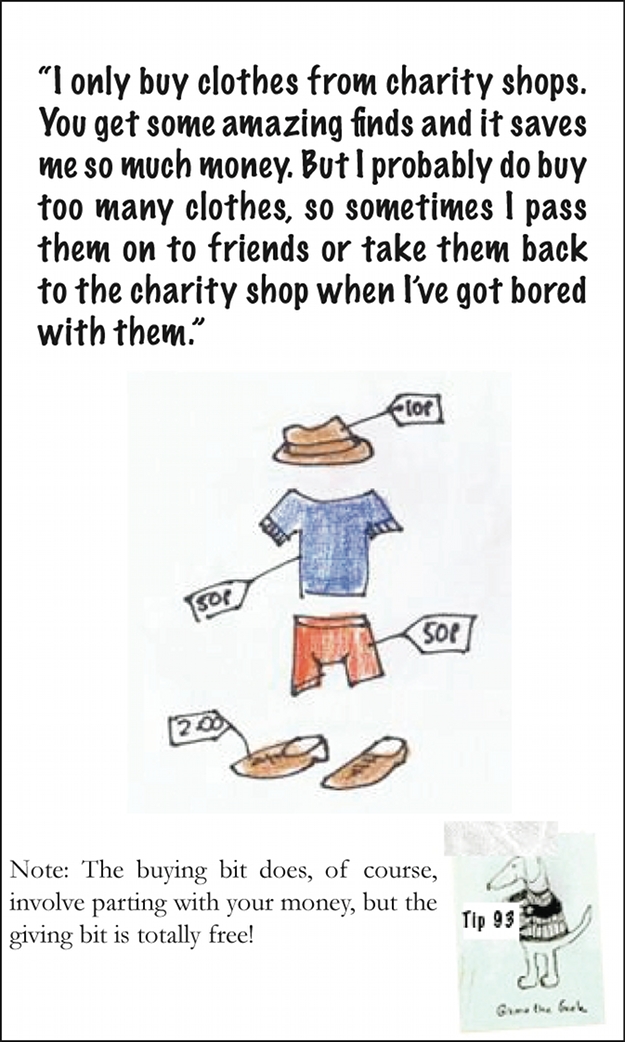
I've made a couple of purchase from other charity shops included this fab top (below) bought from my local community shop for just 50p.

I love this Monsoon top bought for 50p from my local community shop 

I also came across  Swishing.co.uk, a great website that allows you to swish online, using virtual money credits. This summer my daughters and I have tried it out.  You upload photos of clothes you no longer want onto the website and the Swishing team will let you know if they'll take it. There are guidelines on the Swishing website that tell you the kind of thing they will take, but it is pretty obvious and pretty much anything of suitable quality. Your items are then 'approved' and they will give you a 'virtual' price.  If the price is right to persuade you to part with your items and enough to cover postage then you post them off.  Once they are received, you get a credit on your account and you can spend the money on something new (well, new to you!). It is a great place to hunt down something for a party or a wedding. How many of us have an outfit that we've already worn in all our social circles and so it's now redundant in the wardrobe, because we don't want to go out wearing the same thing again?  Well, the answer is to Swish it for something else!

I added three new tops to my wardrobe, all of which I love, and all for a fraction of the cost of anything similar in the shops.  I think it is a great site and I plan to have a regular browse.  I've also decided that it's a much quicker way of finding an outfit for special events.


So...what have I achieved, what have I spent and how does it feel?

I've reorganised and reinvigorated my wardrobe.
I've donated around £100 to charity - from giving and buying.
I've gained around £350 worth of new to me clothes for around £70 (plus a bit of virtual swishing money).
I've had fun with my daughters helping them to go through their clothes and helping them to choose some new stuff on Swishing.co.uk - quality time with daughters - always priceless :)
And it feels so good, I'm not planning on giving up my new purchasing habits at the end of the year.  Eight months in and swishing has become a lifestyle choice I love.  Why not give it a try?


Monday, 22 July 2013

Coping with the Dry Spell

How is your garden faring in the hot weather?

I've just got back from holiday.   When I left we'd had a couple of days of warm weather already, but everywhere was looking green and healthy. I came back this weekend to find my grass looking very brown - not something I've seen for a few years I think.

My Dad came to tell me this morning that he's got all his water saving methods going.  He was heading for the garden carrying his washing up bowl to water the pots on his patio.

"And I've got my shower water to empty for later," he said.


The great thing about grass is that it will always come back green again as soon as the rain returns, so there's no need to water your lawn.  Containers will need watering, but that doesn't always mean you need to use water from the tap.  In dry weather, plants in the ground will fare much better, than in containers.  For the last few years since Frank told us his tomato plant tip, we've planted our tomatoes in the ground so their roots can roam to find their own water.  This is cheaper, greener and way less labour intensive than 'grow bags' which dry out so quickly.


From 101 Ways to Live Cleaner and Greener for Free


In May and June this year, I ran the first pilot of my Dustbin Diet workshops in a local secondary school.  These workshops aim  to raise awareness of how much we waste and to encourage students to think about simple ways in which we can all reduce waste. The students then put together their own version of my book, 101 Ways to Live Cleaner and Greener for Free, which the school can then sell to students, families and friends in order to encourage the waste reduction message.

Several of the students suggested ways of putting waste water to good use and here's a selection of their tips from the first school edition of 101 Ways to Live Cleaner and Greener for Free.


Thursday, 13 June 2013

The Pig Idea

I came across "The Pig Idea" on Facebook today via Tristram Stuart and it really got me thinking and reflecting on all that's happened over the last few weeks while I've been running my pilot Dustbin Diet course.

Yesterday in my DustbinDiet workshop the students were talking about food waste, using up leftovers and also using leftovers to feed pets.  The world has gone a bit mad - thinking that any food that we feed animals has to be specifically engineered for them by humans, hasn't it? Why is it better to feed your cat the same boring diet of highly engineered food pellets, than to share the rest of your tin of tuna with it instead of leaving the tuna to languish in the fridge?  Haven't we all done that at least once - forgotten about the tin of tuna we started until we find it on the next clear out of the fridge?

My mother-in-law's dog eats what she eats, mostly - and no, I don't think they dine at table together when we're not looking, but  Cookie appreciates a bit of gravy and a few peas along with his dog biscuits. There are rules, of course, like no cooked bones, but there's plenty that can go to making up a nutritional meal for both parties.

Ben & Jerry's ice cream manufacturers give their food waste in the US and in Holland to nearby pig farms (apparently they don't like mint).  My Mum used to teach in a local school in the days when schools served proper home cooked meals.  We came home each day with a slop bucket, that would feed our geese.  In return we'd give the school cook goose eggs - because they made great cakes.

How did we get into such a ridiculous state where we can't feed our slops to our pigs?  I had a vague idea that it was something to do with the outbreak of Foot and Mouth Disease but couldn't remember exactly what happened and why the EU ban on feeding food waste to pigs came about.  So I checked out some of the research on The Pig Idea website and this is what they say:

"[In 2001] feeding catering waste to pigs was banned by the British government in response to the outbreak of Foot and Mouth Disease (FMD). It was tentatively concluded that the FMD outbreak originated on a farm that was illegally feeding its pigs unprocessed restaurant waste. The government justified the ban because it considered that there was a risk of infected meat entering the food chain. It was originally intended to be a temporary measure, but a government-sponsored enquiry into the government’s handling of the disease outbreak (the Anderson Enquiry) recommended that the ban be continued. In 2002 it was extended across the whole of the European Union."

That seems a bit like the "no cooked bones" rule being used as a reason never to feed any food waste to your dog.

They also say that:  "With the correct biosecurity measures in place, [feeding leftover food to pigs is safe]. Cooking leftover food renders it safe for pigs, and also for chickens. Pathogens such as Foot and Mouth Disease and Classical Swine Fever are effectively eliminated by heat treatment. Pigs and chickens are omnivorous animals, evolved to eat all the kinds of food that humans eat, and there is no evidence that feeding them properly treated food waste is unhealthy either to the animals, or to humans. That’s why countries like Japan and South Korea encourage this practice instead of banning it."

I think, given the huge problem we have with food waste and the problems we're causing ourselves and the planet allowing deforestation in order to grow feed for pigs it seems time to call for a change.

Check out  The Pig Idea website and sign the pledge.

Of course, we still need to think about the waste hierarchy.  The best way to deal with food waste is not to have any.  But the next best thing is to re-use it. Raising pigs on food waste is the perfect circular economy, is it not?

Image from my "Ice Green Energy" post a couple of years ago
 http://gizmo-the-geek.net/index.php/ice-gree-energy/

Friday, 7 June 2013

An eggs-ellent find

My local butcher has always sold free range eggs and I've bought them from there a few times, but recently they have introduced a twenty pence per half dozen discount if you bring your own egg box.

The eggs are £1.59 per half dozen (with the 20p discount) for large eggs.  Four eggs consistently weigh 266 grammes which makes a nice big cake.  I always weigh my eggs and use equal weight of butter, sugar and flour for cake-making.

Lemon drizzle cake and raisin and oatmeal cookies.

I am really keen to support this kind of reuse system.  It is bound to work well as the customer has the incentive to remember their egg boxes or have the pain of paying 20p per box more.  Carrot and stick is always a good combination.

Cardboard egg boxes are great on the compost, and the cardboard and plastic egg boxes are recyclable and collected by most councils, but reuse generally has higher carbon savings than recycling - and this system of egg box reuse is a perfect - yet oh so simple - example of a carbon saving system.  The Waste Hierarchy (pictured below) shows that the best way to deal with packaging is to prevent it.  If you can't prevent it then the next best thing is to prepare it for reuse and if you can't reuse it, then recycle it.  If you can't recycle it then ideally your method of disposal will recover some value from it - as it would if you were to compost your cardboard egg boxes.  As the Waste Hierarchy diagram shows, binning your egg boxes into landfill is the last resort - and basically shouldn't be happening!

The Waste Hierarchy

Image reproduced with kind permission of Scottish Environmental Protection Agency:
 http://www.sepa.org.uk/waste/moving_towards_zero_waste/waste_hierarchy.aspx

The first time I noticed the egg box reuse incentive (i.e. 20p saving) I didn't have egg boxes with me, but I knew I'd be passing the butcher's the next day, so as soon as I unpacked my meat I retrieved plastic egg boxes from my recycling bin and found a cardboard one that was awaiting being torn up to add to my wormery, and popped them in my bag.  The next day I was pleased with my 60p saving -  it was a cricket tea week - so I needed eggs for sandwich filling and eggs for cake-making.

I noticed yesterday the eggs from the little supermarket in our village were 10p per half dozen cheaper but my daughter bought those a few days ago to make a birthday cake (the butcher was closed) and the four eggs weighed just 214g.

So, I've got into the habit now of keeping my egg boxes in the bag I take to the butcher's, so I can always get my discount.  I'll be cake making for cricket tea this afternoon.  I'm thinking... lemon drizzle, fairy cakes, fruit scones and I might try making some chocolate cookies.


Thursday, 23 May 2013

Swishing

New Year's Eve 2012 - As I sipped my champagne cocktail, awaiting the midnight fireworks, wearing my new favourite dress bought for me, as a birthday present, by my two lovely daughters,  I wondered what my New Year's Resolution would be.

All the usual things came to mind - you know the ones... eat less, exercise more, reduce the alcohol intake!

But I had another idea, inspired by two tips sent in for my book which I thought would be fitting with my mission to get the waste reduction message across.


I decided that I would buy no new clothes (nor shoes, nor any other accessories) for a whole year. I outlined my plan in a blog post in February - in brief, I would buy only second-hand, repurposed or up-cycled items in an attempt to reduce my carbon footprint and save money too.

Fast forward to May 2013: I decided that I would try to wear only second-hand, repurposed or up-cycled items when I piloted my Dustbin Diet workshops and gave talks in schools, and so I took a look at my wardrobe, had a good mooch around my local charity shops and put together a few outfits to fulfil that goal.
Photo: My Eco Activities Day at the wonderful Octavia's Bookshop in Cirencester,
 wearing purchases from my local Oxfam shop accessorised with upcycled necklace by Laura Hounam.

I also came across this fantastic website called swishing.co.uk which will be a great help when I get my workshops in full swing later this year.  With Swishing.co.uk you get to trade in clothes and accessories you don't wear for virtual money credits which you can use to buy clothes from the website that you will wear.

Here's how it works:

Click on the picture to open it fully 

I spoke to the team at Swishing.co.uk and they have set up a special offer code of rosie306 which will get you £1 of virtual swishing money to start you off. They will also give £1 of virtual money to my Dustbin Diet project for each person who registers with the rosie306 code by 30th June this year.  This will be a great help towards being able to encourage some of the young people to think about a more environmentally friendly approach to fashion, so I will be very grateful for your support if you sign up.


I'm now in my 5th swishing month and I've probably bought more clothes than I do normally, but I have certainly reduced my overall spend. In these tough economic times, I'm sure lots of us are trying to do just that.  There couldn't be a better time to take up some new green living money-saving resolutions, don't you think?  

Thursday, 9 May 2013

Pearly Queen


On the hunt for information about up-cycling, I visited a local exhibition by Laura Hounam, who makes up-cycled jewellery.

When I walked into the little museum that was hosting the exhibition I was blown away by the extent of it, the variety of gorgeous pieces of jewellery on offer and the range of up-cycled material that had been lovingly donated, collected and re-purposed to magnificent effect.

The next thing that struck me was the note on the table that told me all the proceeds from the sale of this wonderful jewellery was going to support the charity, Against Breast Cancer.  More about that later...

Let me, first, show you the creations and share Laura's story.


These made me think of all the buttons I've collected over the years.  I always remove buttons from anything that is going to be turned into rags, thinking I might use them one day.  I have a whole box full of them which I think would be better served by donating them to Laura.

These are decorated with donated pearls from broken necklaces.
That's another thing I seem to be collecting! I often find random beads around after parties.  Another broken necklace and the bead pot gets a donation.  I plan to use a few of them to decorate a bag I made from an old T shirt, but then I'm going to donate the rest to Laura.


Next on my clear out list is the array of colourful bits and pieces that fill a whole draw in my hallway.  I have plastic beads, shiny flowers and butterflies galore from when my daughters were little.  Into the 'Laura bag' they go.
Made from an old mattress cover

This beauty, has a wonderful story to go with it.  Laura told me it was made from an old mattress cover.  She grew up in a tenement, apartment blocks surrounding a courtyard.  She remembers when she was little that a man used to come round to recover the mattresses every now and again.  In those days, mattresses were stuffed with wool - the best were made with Scottish wool.  The wool would compact after a while and, so to make them last longer and for hygiene's sake too, the man would come round with his machine that looked like a gondola with spikes sticking out of the bottom, and he would remove the mattress cover, fluff up the wool with his spiky gondola machine and then give the mattress a new cover.


If jewellery from an old mattress cover wasn't bizarre enough, how about rings and brooches made from old tights?
These beauties are made by crocheting old coloured tights.
Laura is often given lots of things with which to create her jewellery, but she also finds some of her materials amongst pieces donated to Against Breast Cancer, to whom she donates all the money she makes from selling her jewellery.

If you have single earrings, stray beads, buttons, belt buckles and that kind of thing you can donate them to Against Breast Cancer, who are in the process of setting up collection points around and about.  If you have items to donate, or you would like to hold a collection point for Against Breast Cancer please contact Jane Terry on 01235 534211 or you can email her - jane@againstbreastcancer.org.uk for more information.


You can see Laura Hounam's jewellery exhibition throughout May at Faringdon Tourist Information Centre.  Laura will also be at craft fairs on Saturday 11th May at St Frideswide's Chruch on Botley Rd in Oxford, on Sunday 19th May at the Food and Craft Fair at Roots Garden Centre in Hermitage and on Bank Holiday Monday 27th May at the craft fair in Bampton Village Hall.  For more dates, you can visit Laura's website. http://hounam.myzen.co.uk