Related Posts Plugin for WordPress, Blogger...
Showing posts with label avoiding plastic. Show all posts

Tuesday, 4 September 2018

Zero Waste Week - 2018 - Day Two

Today's #ZeroWasteWeek challenge is all about the bathroom.

The recycling team that I do events for from time to time, tell me they think many people overlook plastic in the bathroom as an important thing to recycle. Years ago I used to find it an annoying task going through the bin in the bathroom to pick out what's recyclable.  So I added a recycling bin and my problem was largely solved.
Image: 101 Ways to Live Cleaner and Greener for Free
Largely? Well Yes. You have to accept there are some people who are never going to get it! They see a bin and it is just a bin - I hear Junior Daughter's voice echoing: "Why would you put a beer can in the bin that says Food Waste on it?" Sometimes I join in with that despair.  I walk past a bin with a clear plastic bag at the station that says "recyclables" and there's an apple core in it. Yet right next to it is a clear plastic bag for food waste. Is there no hope?

Well I say there is. To me, #ZeroWasteWeek is a great time for raising awareness and being hopeful that just one more person (or more likely several thousand more people, given the huge impact #ZeroWasteWeek now has around the world) is going to think about one more thing that they hadn't thought about before.  And it all helps.

Although my family are now really good at recycling all those plastic items from our bathroom, what we are really not good at is limiting the amount of them that we buy or accumulate in other ways.


It was many years ago now that I had the conversation with Mr Pitt (who travels a lot for his work) about what we think happens to all those miniature plastic bottles from hotel rooms that you've used it bit of and left the rest. Same for those brand new bars of soap.
Well they are clearly going to be thrown away. What a waste!

So we decided to bring them home with us. But then added to all those bottles and boxes of medicinal potions and lotions and things you need just occasionally or keep 'just in case' you need them, it amounts to something like this!

I can definitely see a few duplicates and "nearly finished but not quite" bottles 
The drawer beneath the basin
The box of stuff under my bed from probably before our
 "single-use plastic free year"
that I didn't manage to use up before switching to plastic-free alternatives.
Surely that means I was never going to use them anyway.

So much plastic. Aaahhh!! And this is despite having made the decision in 2015 to switch to unpackaged e.g. solid bar soap and shampoos or refills.  What I didn't do was stop using hotel products at all and I clearly didn't use up everything I already had! Many other things have been either left behind or gifted to us, but ... wow! what a lot of plastic!

What to do? Well I'm open to suggestions but here's my plan:

This evening I'm starting a "Make-up Exchange" and here's how:

1. Separate everything into four boxes:

  • unopened
  • barely used
  • almost empty
  • too old to use

2. Find a home for each box

  • the unopened and barely used will become my "Make-up Exchange" box. I'll clean any eyeshadows that I still have lurking around but won't ever use. I will invite friends and family to take anything they want and anything left will go to a Women's Refuge that has been set up locally. 
  • the almost empty will be the only things available in the bathroom so they get used up.
  • the too old to use will be emptied and and recycled though kerbside collection where possible or else through the Terracycle recycling program which I'm setting up for my local community
3. Use up the stuff to use up and find suitable refillable miniature bottles to take with me when I travel.

4. Return to my solid / refill system at a later date and only buy make-up from brands with a recycling programme such as Lush. 

Here's a bit more about make-up exchanges on another blog post that I wrote and it gives you how to clean makeup too.  

This is another blog post with information about cleaning and extending the use of make-up.

I hope that by this time next year (or even sooner) I will have seriously cleaned up my personal hygiene act. My bathroom will be a properly plastic free zone of peace and tranquility and much quicker to clean - I think that's probably the best bit!

Thursday, 26 January 2017

Plastic Ocean

On Tuesday, I was invited to speak along with a fellow zero waster, Hannah, at The Oxford Waste Society.

The theme of the talk was cutting down on plastic packaging. Inspired by the horrific facts that she learnt about plastic pollution in our oceans, Hannah took on the challenge of living for a year without using any single use plastic. My own inspiration for my family's plastic free year was a little closer to home. I was upset by the amount of plastic waste in the hedgerows and ditches in our lovely Oxfordshire countryside.


It was great to hear about Hannah's plastic free experience and to see all of the life choices that I have made being embraced by someone else. It was really interesting to hear that even though Hannah has now finished her challenge year she plans to continue, as we have.

"How can I possibly go back?" she said.

I know that we have slipped back in some ways. There were things that were hard or not viable to buy without packaging.  The one think I can think of is frozen peas. We tried to grow peas in our plastic free year but they got devastated by some high winds when they were still not strong enough.
I don't know why I don't want to give them up, but I don't.

The other thing that has crept back into our household is packaged crisps. I have almost managed to give them up. But even I cracked last weekend when Mr Pitt opened a packet of cheesy biscuits and I found myself picking at them.

At this point, I should say that our plastic free year wasn't supposed to be about giving up. It was about finding alternatives that were not packaged. We experimented with making home made crisps from vegetable peel and that works well. I managed to switch to snacking on dried fruit and nuts which I bought unpackaged from SESI Oxford. I haven't stopped doing that. When I  find myself nibbling away at packaged snacks at events I stop.
Home made butternut squash crisps

So reflecting on my packaged snacks nibbling last Sunday at home made me think. When you make a conscious decision about something you feel strongly about, it isn't that hard to stick to it. So I have munched my last packaged snack. That's it. I am done with them.

I can't speak for the rest of the family, but I am going to be strong willed and stick to my principles and I will draw support from Hannah's "How can I possibly go back?"

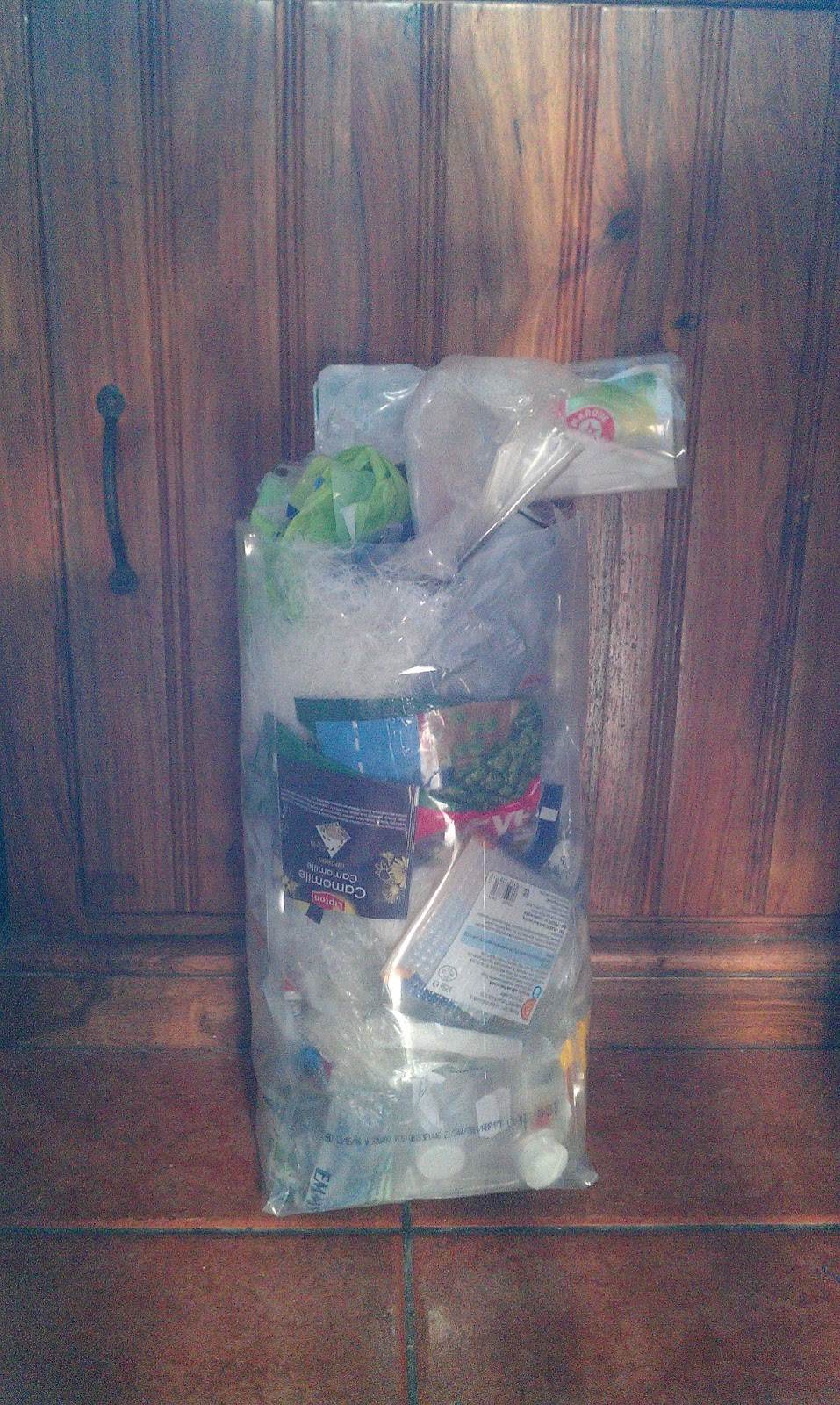
My single-use plastic collected from one year
When we did our plastic free year we ended up with one "plastic cat-food bag" full of single-use plastic and my view was that we hadn't succeeded in our challenge.  It is only afterwards in talking about it at events like the Oxford Waste Society meeting, that I have realised that what we achieved was in any way surprising.  Imagine if this was the amount of plastic produced in every household in the UK.  It is hard to remember how much plastic we produced before the plastic-free year (2015), but I would guess I may have produced four or five times that amount. I didn't measure our plastic from last year but taking a guess I would say it was probably only double. So I'm wondering if seeing and measuring waste in this way has any effect on consumption.

I had a realisation at the beginning of the year that the only thing likely to be in my bin at the end of the year is crisp packets and the non recyclable wrappers from a bag of Cadbury's Roses that were brought to our house at Christmas.

I still think that this waste will be less than an old style plastic carrier bag full over a whole year.  I plan to check, so I am keeping all the wrappers that are non-recyclable in one of my (recyclable, but also reusable for many purposes) cat-food bags to see what we gather in a year.


Wednesday, 28 September 2016

A Food Philosophy

Yesterday I read this interesting article called 7 Small Ways to Begin Your Journey to Sustainable Eating posted by @ReFreshfood on Twitter.


As I read the article, I thought: "This is pretty much my own food philosophy".

1 Meatless Mondays
 We do like to have a roast dinner with all the family on a Sunday, so for us, Mondays often involve eating up the leftover meat from Sunday's joint.  But then on Tuesday, Wednesday and Thursday as long as I've used up all the meat I will then try to keep the meals meat free on at least two out of three days.

2. Buy food with less packaging
I always buy my meat from the butcher in my village.  I take my own containers so there's no plastic packaging.  I also know that my meat isn't going to leak juices all over my fridge so that's an added advantage.


I bulk buy food like flour, dried fruit and nuts, couscous and pasta, again taking my own containers.

I buy veg and fruit from a small greengrocer in a nearby town.  When you buy their produce, which is locally sourced, you will get all shapes and sizes, but it is loose, so you can pick out the shapes and sizes that you want.  If I know I'm going to chop up the fruit and veg, then I'll pick out anything that's a bit wonky, because I want to support them and support local farmers in cutting down waste.  Most of the time, I'll be chopping it and cooking it so I really don't often need it to look pristine.

3. Buy sustainable meat
As, I mentioned, the meat I buy is from a local business, and they source locally.  I make sure I use up every scrap of meat that I buy.  If I want some chicken, then usually I will buy a whole chicken rather than buying chicken breast.

4. Forgo Fish
I do eat fish and seafood, but I look for sustainably sourced and don't eat it often.  I do get my fix, though, if I am by the sea, picking local fish and only where I can sea that wherever is serving it they have a sustainable sourcing policy.

5. Eat seasonally
Absolutely!  As far as I'm concerned, you can forget strawberries most of the year.  Seasonal eating is what makes it special.  The one exception might be that I usually manage to freeze a few batches of blackberries from the abundant supply on my hedge at this time of year.

6. Eat locally
I think we've covered that one already!

7. Lose the bottled water
It is probably getting on for three years now since I bought water in a plastic bottle.  I have a couple of different water bottles and I always take one filled with good old Oxfordshire Tap every time I go out.

And then I thought about one more thing that has become really important to me. So here's my step number 8...

8. Forget the packaged snacks
Last year (2015) my family took on the challenge to go for a whole year without buying anything in single use plastic.  Although we didn't succeed 100%, we did pretty well.  One of the things that I had to do to succeed was to ditch the idea of ever buying packaged snacks out on the go.  This is a habit that we've developed over the last few decades, I'm sure.  I look around me and I see people eating snacks, everywhere, whatever time of day or night.

I'm sure I used to do the same too.  But not now.  I do buy nuts and dried fruit in bulk in my own containers and if I know I'll be out for a while and I'll be likely to get hungry then I will take a container with some fruit and nuts out with me.  But recently, I'm dong that less.  I just came to the realisation that if I'm eating properly, 3 meals a day, there's really no need for the snacks.

Snacks are often just empty calories, full of sugar and salt and SO OFTEN they are packed in non recyclable packaging - my pet hate! So I don't bother (unless I've taken my own.)


Sunday, 28 February 2016

A year without plastic - the good bits

Trying to avoid single-use plastic for a year is the hardest challenge I have tried. The reason behind this strange decision that we took was this: I wanted to see if today’s highly packaged lifestyle is necessary and beneficial or not.  How uncomfortable would it be to manage without plastic packaging?

For me, the most uncomfortable part of the whole challenge is that it involved my family and not just myself.  When I have set myself challenges before, which I do most years, it has really been only up to me whether or not I succeeded in my challenge. Involving other people is always going to be harder, but it can also seem more rewarding - or at least that's what I feel now, looking back on what we achieved as a family. 

It was at times frustrating, like when I asked at the covered market in Oxford if I could have some cheese without any plastic wrapper - the guy said "yes, of course" then snuck in the plastic wrapping anyway. Uhh!  Like when I carefully look for packaging that seems plastic free - I open up a cardboard box and find that inside the contents are wrapped in plastic. But I'm getting wise to that one now!

So, it wasn't 100% successful.  However, it was certainly not all bad. In one year we’ve ended up with a 2.5kg cat food bag filled with scrunched up plastic.  It weighed 770 grams.  Even though I can’t say we achieved our challenge, we have cut down our packaging enormously. I’m pretty sure I used to produce about that much plastic in a month, never mind a year.

Here’s what I’ve learnt.
1. Living without plastic requires organisation. It’s when I haven’t planned ahead that I’ve had to buy plastic packaged goods. Having a good stock of dry goods, store cupboard ingredients and buying cat food in bulk helps.
2. Plastic avoidance requires making sure you take lunch, snacks and drinks with you when you are out and about (a huge money saver!) I have a stainless steel flask for water and I make a lunch of leftovers, or a couscous or pasta salad in a Tupperware container. For that boredom/comfort eating I take a small pot of dried fruit and nuts, which I buy in bulk from refill outlets such as Wholefoods Market in Cheltenham or SESI in Oxford when I’m passing by that way.
3. I bake my own bread, cakes, biscuits and oatcakes. Much tastier than anything shop-bought.
4. I cut out crisps, sweets and other plastic wrapped snacks. For me crisps were the hardest challenge, but finding other snacks like nuts, olives, roasted giant corn and dried fruit has helped. Much healthier!
5. Going plastic free gets easier as you learn how and where to shop. At first I thought I was spending more money, but now I’ve learnt where to shop, I save money.
6.Fresh fruit and vegetables are easily found. Sainsbury’s and Waitrose have plenty of loose fruit and veg, and Coop has some availability. I'm sure other supermarkets are the same. However, the best place I found was a local green grocer - the traditional kind - my local is Alan’s Orchard in Carterton and it really is excellent.
7. I buy good local meat and eggs, unpackaged (as you can take your own tubs/reuse your egg-boxes) at my local Butcher's - Patrick Strainge in Bampton.  If you are in the area - don't miss it! It is well-known for its award winning sausages. They also have wonderful pasties, sausage rolls and that sort of thing, which we've used as a way of keeping our holiday travel plastic free.  We have just taken a big tub with a clip lid with us on the day of departure (or the day before) and filled it with goodies.  Much nicer than anything I've ever had from a plastic packet.

So that's the good bits. What about the bad bits? Cheese, cucumber and peas unpackaged? Forget it. Way too stressful!


Monday, 7 September 2015

Zero Waste Week - Day One

Today is all about plastic.  Couldn't be a more appropriate place to start for me!

I'm now into my 9th month of trying to live without single use plastic.  It has been a challenge and we have started to crack.

Last week we went to the supermarket to buy the necessary for cricket tea and for some reason it turned into a family outing.  Junior Daughter asked "What's for tea?" and I replied that I was planning to make a curry.  "Can we have poppadoms?" she asked.  I was planning to have a go at making poori from scratch to avoid purchase poppadoms which are only available in plastic packaging, but I couldn't bring myself to have the discussion.  I have been getting the feeling that the family are fed up with this zero plastic challenge. And that's hardly surprising because it is so hard to achieve these days.

I was later informed that the particular poppadoms chosen were because they thought the packaging was more easily recycled than the film-type packaging.  This is true, but it is none-the-less single use plastic packaging.

I also discovered that a sizeable quantity of Diet Coke had been purchased and rather than the individual bottles - which we long ago decided were exempt from our 'no plastic' efforts - they purchased 2 four-packs, which are wrapped in film plastic.  I didn't ask, but just know that these were undoubtedly cheaper than the individua bottles.  Annoying that anything with extra packaging is cheaper than the option without the extra packaging.  It shouldn't be allowed!

Added to that when I took my large reusable plastic tub to the cheese counter, the man serving me insisted that he wrap the cheese in the two plastic sheets he had to use to weigh the cheese and place it in the container.  I was screaming with frustration inside, but just smiled and said thank you and went on my way.  Sainsbury's, if you are listening, why does serving cheese have to involve so much plastic?  Some people on the cheese counter seem to understand that if I take the trouble to bring my own reusable tub to buy my cheese, then clearly I don't want to be lumbered with a load of plastic waste.  But other people just don't get it!  Do I give up trying?  Or do I persist in my efforts to reduce this waste?

But back to the positives of plastic reduction…

Inspired by today's Zero Waste Week email, I decided to take a look at the single use plastic that I have in my house, despite managing to largely avoid it for more than eight months.  At the start of my zero plastic challenge I realised I had quite a lot of the stuff already, and of course I don't want to waste anything, so I knew I would gradually use it up.  I decided in order to try to measure how much new plastic packaging I was introducing through the year, that I would put out any plastic packaging from prior purchases into my recycling bin on a weekly basis as before.  I'm only collecting up this year's plastic packaging.  I remember also wondering how long I would still be generating packaging from things already in stock.  Well, the plastic is diminishing steadily, but there's still some around.

Today, then for Zero Waste Week I'm going to gather together all this plastic and see if I can use it up during the week.

Keen to take immediate action however, I'm also going to tackle another plastic pile-up that regularly annoys me.  Like most people, I imagine, I have a bag full of plastic carrier bags I dip in to when I need one - such as for giving things away. I rarely use these for shopping as I have plenty of reusable canvas and jute bags.

I am pretty sure that I haven't personally gained a plastic shopping bag at all this year, so I don't understand how I come to have soooo many bags.

I can only assume that they've beed breeding in my cupboard.  Although we always seem to need plastic bags on regular occasions, we have accumulated so many, that I'm confident that if I part with these bags - every last one of them - today, we will by the end of the month have somehow accumulated more.  So I'm taking them to the recycling point in Sainsbury's.  Yes, I'm returning some of their plastic for them to make back into plastic bags (or more plastic sheeting for their cheese counter maybe?).

How long will it be, do you reckon, before my string bag is brimming full with plastic bags again?

My final plastic reuse challenge for today is to mend this rather sad looking drying rack!


I'm sure I can find something that will bring it back into life.


Saturday, 28 February 2015

The plastic challenge two months in

We are now two months in to our plastic challenge and I think we can now say that we are getting in to the swing of things.

There are some things, that I don't think we can avoid, but even with such things we are finding ways to lessen the plastic packaging just by doing things slightly differently.

At the end of January, I had to buy more cat food and so returning to Countrywide to purchase their own make cat food again, I found them out of stock of the 2.5kg bags, but they did have 10kg bags.  I checked the ingredients against the photo I had taken on my phone and found them to be the same, but first I had to solve the problem of how to store this much larger quantity for a much longer time.  Countrywide couldn't help with that, but Poundstretcher sell a 'Pet Pantry' at a cost of £14.99 which seems to do the trick.  Even with the expense of the pet pantry it was a lot cheaper buying it in bulk. I'm hoping the pet pantry keeps the food fresh for long enough.

Smarty is checking out the new cat food
One of the most annoying things we're finding is that some shops charge more for unpackaged veg than for packed veg.  That seems totally wrong, to me. We haven't really been monitoring the price differences up to now, just getting annoyed by them.  But, I'm planning to monitor them carefully from now on to build up an accurate picture of who is doing this, when and where.

Today's challenge is a fundraising event in our village - the cricket club quiz - which involves bulk buying beer and wine and we usually serve various low budget salty snacks at each table.  The snacks will look a little different this year as we'll be serving Bombay mix, peanuts, giant corn and Japanese rice crackers all of which I've bought in  bulk in my own containers at Whole Foods Market on my way past earlier this week.  We were worried that the beer would be a plastic problem.  At Booker, we compared the price of crates of cans of beer which are wrapped in plastic with the crates of bottled beer wrapped in cardboard and the price of the cans was much cheaper.  We looked at the possibility of barrels of beer but we don't have enough people drinking it to warrant a barrel of bitter plus a barrel of lager plus a barrel of cider and once these are started, my understanding is that they have limited shelf life. On the other hand, we always just keep any left over cans to sell at the next event.  However, we checked out Sainsbury's and found that their cardboard wrapped cans were on a par with the plastic wrapped crates at Booker so we managed to purchase everything plastic free.

We've been asked to provide dips and crudités for Junior Daughter and at first she seemed reluctant for me to do this with her or for her 'because of the whole plastic thing', but I persuaded her that home made dips would be a lot nicer than shop bought dips and she agreed.  I wanted to buy a cucumber and some celery along with peppers and carrots, but as we were timing our trip into town to pick up glasses for the Quiz night (you can borrow glasses from Waitrose free of charge) I didn't manage to get to the market in time.  Waitrose and Saisnbury's only had wrapped celery and wrapped cucumber, so I took the decision to just buy peppers and carrots.  I pointed out that these were always the favourites anyway, so Junior Daughter didn't seem to mind.

All in all our plastic purchases are minimal, but we have still generated lots of plastic packaging from things we already had in the house.

Two months worth of plastic packaging

Never-the-less, it certainly makes a mountain of difference.  I'm pretty sure I used to put out this much plastic every week.


Saturday, 10 January 2015

Scrapping the single use plastic packaging

Can it be done? What will life be like without single-use plastic?

I thought I was going to lose junior daughter and Mr Pitt on day one. New Year's Day in the Pitt household is traditionally a day for chilling out and eating snacks.  Junior Daughter had friends staying for New Year and so when she took them home Mr Pitt instructed her to buy snacks. Please remember the plastic free bit, I urged and received back a 'don't worry, Mum'.
Soon I get a phone call asking what she could buy. Maybe tubs of nuts, was my suggestion. But she couldn't see anything in a reusable tub. Then I cracked and said that I couldn't think of anything and I wasn't going to be eating them anyway. (Not true!)
A few minutes later I get a text:
"There is 100 per cent nothing I can buy."
I wasn't sure what to expect. But she did indeed come back with nothing. I raided the snacks cupboard and pulled out a few unfinished packs of crisps and found a tub of Yorkshire Crisps from a hamper I had been given for Christmas. I thought it was bound to have a plastic inner. But No. The tub is on its third use now full of roasted peanuts from Whole Foods Market. It has already transported sugar from SESI Oxford to the fairly heavy glass storage jar I use. Mr Pitt also came to the rescue with a yummy tortilla - a Spanish tapas dish he made from fried potatoes, onion, marjoram and thyme, fried up then transferred to a quiche dish, covered with beaten egg and then grilled.  So we had a lovely film and snacks evening after all.

The snack attack issue was solved on my trip to SESI Oxford. When I stocked up with dry goods like flour and sugar, I bought peanuts and raisins in my own Onya Weigh bags. JD is taking these to school daily in a Philadelphia cheese tub. Then in Whole Foods Market I filled my Yorkshire Crisps tub with salted peanuts and bought dried salted broad beans, giant salted corn and Taiwanese Chilli Rice Crackers in my own containers. Today we will make a batch of mini cheese biscuits and some banana bread.

So far we have still been producing plastic from using up stocks, but we've managed to do all our shopping totally naked. So, off to a good start.

Using up the stocks.  This is the plastic we have generated in a week.


Wednesday, 31 December 2014

Happy New Year!

If you've read my blog before, you might know that I love a New Year's Challenge.  In 2013 I did a year of Swishing which changed my attitude to shopping completely. This year I pledged to buy no  new books (except as birthday presents).  I've managed far more trips to the library and got pretty organised about ordering books for collection - a great service that libraries provide.  I've also given away 10 books each month - well - at least up until November.   When I finish this blog post I'm going to select my final 10 books for 2014 and then contemplate whether I can possibly carry this on into 2015.


But even if I do carry on the book challenge, I always like to have a new challenge too.  And next year will be, without doubt, the toughest yet…

A year without single use plastic.

This is not something I've just dreamt up today… oh no.  I, or rather we - the Pitt family - have been contemplating it for a while now.  I think it was around October time that I first suggested the challenge to Mr Pitt.  He was tucking in to a packet of crisps at the time.  "Can't be done!" was the initial reaction.  But then gradually came more and more comments like "We won't be buying anymore of these, then."  Soon after that came Mr Pitt's home-made potato peel crisps.

We've been doing our bit for naked shopping for a while now, so we are well practiced at buying fruit and veg packaging free and in recent months I've discovered options for buying a whole range of goods packaging free.  You can read more about this in previous blog posts.

A fairly typical Pitt shop.


So why are we doing it?
Firstly, we have been a 'Zero-Waste' household for quite a while now.  It is many years since we had a rubbish bin in the house and because of that we always think of our 'rubbish' not as 'rubbish' but as 'resources' and as such we put what ever it is we have finished using into the appropriate place to be reused or recycled.  We don't just 'throw away'.

But, over the years that I've been researching waste management and recycling for my books, and talks as well as my own family life, I've started to look more carefully at what I do and at what businesses and organisations do in terms of waste.

As I see it now, there are two schools of thought about Zero-waste.  There's firstly the 'Zero-waste to land-fill' school of thought and that's what we've managed to achieve for many years now.  But how?  Well, there has for a long time been very little in Oxfordshire that doesn't get collected for recycling.  The local council here even collect quite a lot of 'flyaway plastic' as long as it is clean and bagged up so that it doesn't fly away to pollute the countryside when they are collecting.

But there're still a few things that aren't recyclable - and guess what - these are all mainly plastic or plastic based packaging items.  We have generally tried to avoid such items, but when we have had them, we have disposed of them by using them to light our wood burning stove and wood-fuelled cooker.  Plastic is much better than paper at this task, doesn't stink like firelighters, but I don't know the full extent of the pollution it may be causing in the atmosphere.

The second school of thought is not just Zero-waste to landfill, but Zero waste at all. And that's where I want to be a year from now.  I'm not wanting to demonise plastic completely, but it is responsible for a great deal of pollution on our lovely planet.  Our oceans are full of the stuff and it is high time we did something about it.  So I've taken a good look at what we consume, how we consume it and how we pass it on to its next purpose - whether that  is to be reused, recycled, composted or burnt by us or by the local council at its new energy from waste plant.  My conclusion is that to move from Zero-to landfill (we are 99.99% there) to being Zero Waste, it is the single use plastic that we have to say goodbye to.

Home-made potato crisps

Home-made butternut squash crisps

Dry goods you can buy in your own containers at SESI, Oxford

Weighing out dried mango at SESI

My packaging free dry goods will come from SESI.  It is easy
 to buy and store enough for three months.


Now why do I think it is going to be so hard?

Our lives are so full of plastic.  It is everywhere we turn.  In the last couple of months I've been really taking note about how much stuff we have that came here by means of plastic packaging.  We use plastic all day, every day it seems.  If we wanted to say that from the 1st of January to 31st December 2015 I would use nothing that involved plastic a whole lot of stuff would go to waste - and we don't do WASTE.

So what can we do to achieve our plastic free - zero waste lifestyle?

These are the Pitt family rules for our plastic free 2015:
1. Buy nothing new that has any plastic in it or around it.
2. Collect and weigh all recyclable plastic that arises from purchases already made in order to raise awareness of the plastic in our lives.  We will recycle or keep this plastic for reuse.
3. Collect and weigh all non-recyclable plastic that arises from purchases already made.  We will accumulate this and photograph it and hopefully see it diminish month by month.

A selection of oils and vinegars I can buy in my own containers
I will hopefully be keeping you posted of our progress as we gradually eradicate single use plastic from our lives.  If not then I'll be sharing a moan or two.

Locally made washing up liquid.
  I'll take my own bottles to refill.

Can we do it?  How long will it take to be single-use plastic free?

One month?
Six months?
A whole year?

We'll see.  Bring on the 2015 challenge. Happy New Year!

Thursday, 30 October 2014

Shopping Naked

It has been maybe ten years now that the Pitt family have only needed to put their 'general waste' bin out for collection once or twice in a year and even then it hasn't had much in it.  This was the photo of our entire residual waste for 2013.

Residual Waste for 2013
Now, it helps, of course, living in West Oxfordshire, where there really isn't very much at all that can't be recycled in your kerbside collection boxes - and they even take flyaway plastics as long as they are bagged up so they don't fly away during the collection process.  I've also actively taken steps to think about my residual waste each year and have tried to avoid buying things that can't be reused, recycled, composted or burnt on my stove - or things that have packaging that can't be recycled, reused etc.  And I've done that for a while now, so zero waste has become a habit.

But, this morning I put out four black boxes each of which was fairly full of recyclables. I'm pretty sure I put out four boxes, if not five, the week before and similar the week before that.  That's a lot of packaging for one family.  I have taken in the recycling from the cricket club annual dinner and we also had a rather large 18th birthday party, but it really has none-the-less got my attention. So I decided that over the next few weeks I'm going to really try hard to reduce the amount of packaging I amass.

We have for a long time bought much of our fruit and vegetables loose and last year I converted a patch of garden to grow salad herbs in order to provide unpackaged salad leaves.  My local butcher will accept my various reusable plastic boxes for when I buy meat.  I've been experimenting with making homemade snacks, particularly to reduce food waste as well as to reduce packaging.  But there are still so many things that come in a plastic bag.

I came across this write-up of Whole Foods Markets supermarket chain on the plasticisrubbish.com blog and it dawned on me that on one of my now very occasional journeys that I still make by car I drive right past the one in Cheltenham.  So today, I went prepared with a reusable shopping bag and my tiny bag of 'Onya Weigh Bags' - which are reusable, washable very lightweight mesh bags and checked out the Cheltenham branch of Whole Foods Market.

The selection of fruit and veg looked very inviting, but I had come to investigate those cupboard store ingredients like dried fruit, cereals, rice and pasta that are rarely found sold loose.

I came away with the following haul:


1. UK sourced jumbo oats at £1.09/kg.  The last box of oats I bought - because it was the only one I could see that was UK sourced with entirely recyclable packaging - is currently £2.70/kg in Sainsbury's.

2. Organic arborio rice £2.99/kg.  The last box I bought was priced at £2.20/kg from Sainsbury's.

3. Brown basmati rice at £2.39/kg.  Sainsbury's brown basmati rice is £1.80/kg

4. Organic raisins £5.99/kg. Sainsbury's organic raisins are £5.00/kg but the raisins I usually buy there are £3.00/kg.

5. Dry roasted peanuts £5.39/kg.  The cheapest dry roasted peanuts in Sainsbury's are £4.40/kg but I wouldn't buy them as the packaging isn't recyclable even in West Oxfordshire.  The ones I'd likely buy were £6.70/kg.

Price wise, it seems you win some you loose some.  If I'd bought around a kilo of each item then given the 30p discount Whole Foods Market gave me for using my own bags then I paid £1.15 more than I'd have paid buying what I'd normally buy at Sainsbury's or 85p less if I'd have chosen organic raisins.  I did a taste test on the raisins I had left at home and the ones I'd just bought and the latter were definitely tastier.  I doubt that's just down to freshness as raisins don't last long in our house.

So price-wise I felt it was ok and quality wise and packaging wise I'd give it top marks.  I love the fact that I would soon know exactly how much I can buy to fill my storage containers for each item and I loved the fact that I was left with no packaging to recycle.  I also cheekily took the opportunity to check out my Onya bags on the scales compared to the paper bags the shop provides and my Onya bags weighed a tiny bit less.  I will be shopping there again next time I pass.

I was only disappointed that there was no bulk buy plastic free pasta.  So it looks like I will have to try and make my own :)


Monday, 1 September 2014

Zero Waste Week 2014 - Day 1

I've been looking forward to Zero Waste Week and seeing through my pledge.  I found that I've been thinking about it on and off for the last few weeks, making mental notes about what I'll need to tackle and wondering what I'm going to part with.

As you've probably guessed, I love this year's Zero Waste Week theme of 'One More Thing'.  I wrote a whole book of things we can all do to reduce waste, but there's always one more thing.  There's always room for improvement  and this week, I'm going to try to do just that.

My Zero Waste Week pledge - my 'One More Thing' to reduce waste -

…is to go through each room and pick out at least three things that we no longer use, but can't give away as they are because they need some kind of attention.  I'm pretty rubbish at mending stuff.  I have good intentions, and I never just throw something away.  But I do find that I procrastinate instead of just dealing with broken things straight away.  So, I'm going to use this week, to try to develop my mending skills and try to kick the habit of letting things build up in the hope that I'll sort them out one day!

In addition to that I'm going to join in with the Zero Waste Week daily emails and find something more each day that I can be doing to reduce my use of resources.

So, what am I mending today?

I decided that I'd start in the spare bedroom as I know that there's lots of stuff in there, hidden in drawers and under the bed and there's at least one box that is full of stuff with bits missing, so I thought it would be easy to pick out three things we could part with and get off to a flying start.

First up, I decided to take the plunge and address these lovely ladies…

They have been long neglected atop the spare room wardrobe.  They get a very occasional dust, but they are really a bit sad and unloved.  I brought them down from their perch to investigate whether they could be cleaned up to be given away, and found that the clothes were removable and washable.   They've been through the wash, and are now out on the line and hopefully they haven't shrunk.  If I can dress them up again, then they will go to the charity shop, to see if they can find a new home.

Next up, hanging on some wall hooks I found a stash of unwanted jewellery, which I've add to my collection of broken beads, ribbons, single earrings and cufflinks, buttons, jewellery boxes and old watches, which I collect up for the charity, Against Breast Cancer.  A lovely lady, Laura Hounam, who I've blogged about before, takes these bits and pieces and turns them into wonderfully desirable and modern jewellery that she sells at craft fairs and exhibitions to raise money for the charity.

Third up is a dressing gown, that has somehow escaped the charity bag for all these years.  That's gone into the washing and will be added to the charity shop clothes bag that I've started up.

That wasn't so hard!  But I'm still left with the box of toys and games from last year's clear out.  I've decided to keep this, in the hope that as I go through each room, I might find the missing pieces.  If not, then I'll have to have a re-think at the end of the week!


Onto my Zero waste week daily email that awaited me this morning!  It's all about plastic, with lots of suggestions for how to reduce the amount of single use plastic we all use.  Plastic is one of those things that because there are so many different types, some local councils choose not to offer a collection service.  Pretty much all plastic can be recycled and the myth that it all gets shipped to China and landfilled is very far from the truth.  There are many companies who recycle plastic here in the UK.  I know that, because I've visited several of them!

But despite the fact that most plastics can be recycled and I live in area that does take almost all of it in the kerbside collection boxes, it is still something that I try to cut down on.

I always keep a few plastic bags in my various handbags and rucksacks.  We keep plastic bags in the boot of each car, so that we are not caught out shopping without a bag.  We buy most fruit and veg loose, and if not, then again we reuse the bags and put them back in with our shopping bags when we unpack the shopping.  We take our egg boxes to the butchers to refill with local eggs and we also take our own plastic containers for our meat purchases.  We use various tupperware pots for packed lunches.

So, I've I hopped over onto the blog post to see what 'One More Thing' we could do to reduce the amount of plastic recycling we end up with and here's the plan…

The plastic packaged thing we don't seem to be able to do without in our family is crisps.  The problem with crisp packets is that they are made from mixed materials which apparently makes them too difficult or costly to recycle.  So the only way to avoid this waste is to do without them or make our own.  I have a gadget that will cut slices of root vegetables very finely, so this evening I'm going to give it a whirl.  Anyone got any tips for DIY crisp making?


Wednesday, 4 June 2014

Just how much plastic do we need in one bathroom?

I came across this campaign today run by The Story of Stuff.

http://act.storyofstuff.org/page/s/microbeads-5gyres?utm_source=SOSsocial&utm_medium=Facebook&utm_campaign=Microbeads-Natl


I had no idea until I read this that things like face cream might contain tiny beads of plastic.  These plastic microbeads are abrasive and so are used as an exfoliant, to wash away the dead skin particles.  Yes wash away.  There lies the problem.  These particles are, by design, made to be washed down the drain, which means they are going to end up as pollutants.  Did no one think about that as a problem when they came up with the idea?

Our consumer culture is doing us no favours as well as harming the environment.  People invent these things, without thinking through the consequences for the environment.  That's why it is so important that we help the next generation to see the effect on the environment as being the most important part of any business or product.  'Do no harm' needs to be at the forefront of our minds as we find, develop and trial new things.

I hate the thought that many of us who care about the environment may have been using such harmful products without realising.

It makes me wary of buying any cosmetics.

At the beginning of this year my sister asked me to help her with a clear out of some cupboards.  She said she'd 'got it down to three boxes of odds and ends' that she couldn't face going through and knew that she'd likely have put it all in the bin if she didn't have a zero waste sister!  I sorted through the boxes and found homes for everything - mainly through reuse and recycling schemes run by charities.

But I did bring home a bag full of various cosmetic products - bottles of shampoo, conditioner, shower gel - some half full, some with just a small amount in.  I did suggest to her that she could use these up and then recycle the bottles in the normal curb side recycling collection.

"But I've got a bathroom full of the stuff already!" she protested.

So I said I'd use it up myself.  I used to think I was frugal about making sure I use every bit of a product, even rinsing out the bottle as the last use of it.  The more you use up and the longer you make it last, the better - I think - as all these things take energy and raw materials to make and transport to the end user.  But when I got back home and looked at what I had in my own bathroom, I was dismayed to realise just how many plastic bottles with varying amounts of content I had accumulated.


So, I made a pledge to not buy any more cosmetic products until I have nothing left.  We're now in June, I've bought nothing, yet I still have a whole tub full of cosmetics.  I may well get to the end of the year without buying any more, and when I do finish up my current stock and recycle all those plastic bottles, I'll be thinking very carefully about what I buy in future.

I don't know if the products I already have contain plastic within them.  How do I find out if they do, I wonder?  And if they do… what do I do with them?

All these cosmetics are staying in the plastic tub.  They are coming out one product at a time and being used up before selecting the next one.  I guess that means I can be careful to read what's in them (if I can read the tiny print) but what do I do if I don't like what I find?  It seems I can make no difference now, having bought or acquired the stuff.  It just goes to show how important it is that businesses are ethical and considerate in their research and development, because once something is made - it is sometimes too late to undo the harm.