Related Posts Plugin for WordPress, Blogger...
Showing posts with label #ZeroWaste. Show all posts

Monday, 18 February 2019

Do you want to be a Waste Warrior?

I was at the opening of an exhibition in our local village history archive, and someone said to me:

"How does it feel now that the rest of the world is catching up with you?"

He had interviewed me for a Food and Drink programme on local television. That's how he knew about my "one bin a year" waste habit and like many people, he always takes the opportunity to tell me what he's managed to change to reduce his waste.

It does really feel like we are nearing the tipping point, thanks probably to the brilliant effect of the BBC's Blue Planet 2, but perhaps also the growing number of Waste Warriors like me who are talking, blogging and chatting to people about how they've reduced their waste. I really do feel that soon my one bin a year lifestyle could become  the "new Normal"!

While I was busy making some films about how to reduce food waste over Christmas, and writing a new Zero Waste campaign guide for schools, my partner in grime Rachelle Strauss was downloading her own zero waste expertise into a fantastic new Waste Warriors course - a series of podcasts that help you take action to gradually get from where you are to where we are in a month (well, that's if you do the 5 minutes a day, every day). Of course, the FOMO kicked in and I had to do the course myself to experience it and to check that I was doing everything I could to be the best waste warrior I can be.

Did I learn anything? Have I made any changes as a result? Given that the course is based on the many discussions that Rachelle and I have had over the 5 years we've worked together, I knew that I'd be doing most of the things she would be suggesting. And of course I was. You can't live on one bin a year without doing most of them.

But yes, I did make some changes.

Firstly, the course raised the issue of plastic in tea bags.  In 2015, when my family did our year without single use plastic packaging, we swapped the tea bags for loose leaf tea that we bought straight into our own containers. The shop I bought from at the time has sadly closed down, but I can now buy loose-leaf tea in Whittards. Back then my reason for changing to loose-leaf tea was because so many tea brands wrapped their cardboard boxes in film plastic - or even more annoying to me, put their tea bags inside a non recyclable silver bag (made of mixed materials - hence too hard to recycle). But I had no idea back then that tea bags themselves were sealed using plastic.  In fact it was only last year that Garden Organics changed their advice from saying that you can compost tea bags, to suggesting that you don't compost them at home, because of this plastic content.

Anyway, thanks to the waste warriors course I've gone back to drinking loose leaf tea - and, do you know what? It is soooo much nicer!

Another thing that the course pushed me to do is to tackle my growing mountain of things that could be given away and therefore put back into use instead of lurking in "Harry Potter's Bedroom" (everyone has one of those, right?).  My Dad had two discarded fleeces that he gave me to dispose of as I saw fit. I washed them, but they still came out covered in those sticky things from the garden and the silky strands that cobwebs turn into when you wash them.

I got out the ironing board and clothes brush and while I was listening to an audio book, I painstakingly went over every inch of the fleece to remove these sticky bits and now it is ready for the charity shop. I still have the other one to do, but I'm starting tonight.

Change number 3, is the decision to pick up more litter. I go running. Never as often I would like, but I do manage to get out there occasionally. My new habit is to run past my house for a certain distance and then walk back picking up the litter I see on the way.

This is today's haul. I'll wash and recycle all of this in the various schemes I use. Better than it staying in the hedge and finding its way to the ocean one day.


So, if you feel like you're ready to be a waste warrior, or you're already one like me but just want to take it to the next level, I do recommend the course. Here's the link.


Monday, 14 January 2019

What a waste!

I was out jogging just now and picked up this from the verge!


I couldn't believe that someone is not willing to share their teabags, yet they are prepared to let them rot on the roadside. A sad waste.

There seems to be more and more rubbish on our roadsides these days and the problem is getting worse not better, I feel.  It is not just packaging that has gone crazy, but our whole attitude that we can just throw something away and not worry about it any more. More than ever this year, I want to do my bit to minimise waste, encourage others to do the same and to be really strict with supporting companies who are making the change to a circular economy.

That's my wish for 2019.

To help me maximise this target I've signed up to Rachelle Strauss' Waste Warriors course as although much of the content is what I cover in my books, I know there are steps further into the course that even I've not dabbled with yet.

Without wanting to give away too much of what's in the course the first two days are all about motivation and what makes you want to reduce your waste. What's your big why and what will keep you sticking to your new principles when you get short on time and tempted to waver.  I've been on a zero waste journey for such a long time now, I realised as I was listening to the course (it is a daily 5 minute audio accompanying a simple call to action), that I have forgotten my own 'big why'! What made me start to radically reduce my waste in the first place?

I really, honestly can't remember any single incident that made me decide to reduce my rubbish. For me it is just that I don't like waste! So I had a little look back at the pictures on my phone and found this one.


For now this is my big why! This really shouldn't be necessary these days. We have the technology and the understanding to be able to preserve resources. Manufacturers and suppliers just need that little push in the right direction, to use that technology and understanding. We, the consumers can give them that push.  Let's make 2019 the year we do things differently - the year we make that shift to valuing our resources rather than throwing rubbish away.

Time for a cup of tea?


Tuesday, 4 September 2018

Zero Waste Week - 2018 - Day Two

Today's #ZeroWasteWeek challenge is all about the bathroom.

The recycling team that I do events for from time to time, tell me they think many people overlook plastic in the bathroom as an important thing to recycle. Years ago I used to find it an annoying task going through the bin in the bathroom to pick out what's recyclable.  So I added a recycling bin and my problem was largely solved.
Image: 101 Ways to Live Cleaner and Greener for Free
Largely? Well Yes. You have to accept there are some people who are never going to get it! They see a bin and it is just a bin - I hear Junior Daughter's voice echoing: "Why would you put a beer can in the bin that says Food Waste on it?" Sometimes I join in with that despair.  I walk past a bin with a clear plastic bag at the station that says "recyclables" and there's an apple core in it. Yet right next to it is a clear plastic bag for food waste. Is there no hope?

Well I say there is. To me, #ZeroWasteWeek is a great time for raising awareness and being hopeful that just one more person (or more likely several thousand more people, given the huge impact #ZeroWasteWeek now has around the world) is going to think about one more thing that they hadn't thought about before.  And it all helps.

Although my family are now really good at recycling all those plastic items from our bathroom, what we are really not good at is limiting the amount of them that we buy or accumulate in other ways.


It was many years ago now that I had the conversation with Mr Pitt (who travels a lot for his work) about what we think happens to all those miniature plastic bottles from hotel rooms that you've used it bit of and left the rest. Same for those brand new bars of soap.
Well they are clearly going to be thrown away. What a waste!

So we decided to bring them home with us. But then added to all those bottles and boxes of medicinal potions and lotions and things you need just occasionally or keep 'just in case' you need them, it amounts to something like this!

I can definitely see a few duplicates and "nearly finished but not quite" bottles 
The drawer beneath the basin
The box of stuff under my bed from probably before our
 "single-use plastic free year"
that I didn't manage to use up before switching to plastic-free alternatives.
Surely that means I was never going to use them anyway.

So much plastic. Aaahhh!! And this is despite having made the decision in 2015 to switch to unpackaged e.g. solid bar soap and shampoos or refills.  What I didn't do was stop using hotel products at all and I clearly didn't use up everything I already had! Many other things have been either left behind or gifted to us, but ... wow! what a lot of plastic!

What to do? Well I'm open to suggestions but here's my plan:

This evening I'm starting a "Make-up Exchange" and here's how:

1. Separate everything into four boxes:

  • unopened
  • barely used
  • almost empty
  • too old to use

2. Find a home for each box

  • the unopened and barely used will become my "Make-up Exchange" box. I'll clean any eyeshadows that I still have lurking around but won't ever use. I will invite friends and family to take anything they want and anything left will go to a Women's Refuge that has been set up locally. 
  • the almost empty will be the only things available in the bathroom so they get used up.
  • the too old to use will be emptied and and recycled though kerbside collection where possible or else through the Terracycle recycling program which I'm setting up for my local community
3. Use up the stuff to use up and find suitable refillable miniature bottles to take with me when I travel.

4. Return to my solid / refill system at a later date and only buy make-up from brands with a recycling programme such as Lush. 

Here's a bit more about make-up exchanges on another blog post that I wrote and it gives you how to clean makeup too.  

This is another blog post with information about cleaning and extending the use of make-up.

I hope that by this time next year (or even sooner) I will have seriously cleaned up my personal hygiene act. My bathroom will be a properly plastic free zone of peace and tranquility and much quicker to clean - I think that's probably the best bit!

Monday, 3 September 2018

Zero Waste Week - 2018 - Day One

This year's Zero Waste Week is, of course:

 all about plastic!

I wrote earlier in the year about the Blue Planet effect and what a hot topic it has become. Thank you to the BBC and to the wonderful Sir David Attenborough for making plastic pollution such a hot topic.


Campaigns such as The Last Straw and Recycle Now's Plastic Planet fill me with hope that soon the life choices I make won't seem weird, but will just become normal life, for most people. Back in July 2014 I first went to my local butchers with my reusable plastic tubs and talked to them about Plastic Free July and said that I was planning to try to cut out single use plastic for a whole year.  They were very supportive and I've been taking my reusable tubs there ever since. Just from that small decision, I've started a trend.  A few months ago, I they told me I was one of four families now doing the same thing. Then a few weeks ago, I found out that the four has grown to five.  Who will be number six, I wonder?


But why do this?  What's the point of it all and does it help?  When I wrote my first book, 101 Ways to  Live Cleaner and Greener for Free, it was partly a reaction to feeling that every time I looked for a sustainable alternative to what I was doing or buying, it seemed to cost me more.  Take cotton buds, for example, it is not something I use very often, but I was really annoyed to find that a compostable cotton bud was more than twice the price of a plastic version. Composting toilet compared to water based system - beyond expensive..beyond my reach at the time. A growing sense of despair at finding that our growing convenience consumer lifestyles were 'costing the earth', yet the green alternative was 'costing the earth' in a different way, led me to take a look at what I could do for free in order to reduce the impact my family has on this planet. And the big thing was, I wanted to know if it made a difference. And so, I started to take a look at the maths and science behind various ways of saving resources and that became the focus of my book.


Today, we've become quite adept at taking our own bags to the supermarket. When I wrote my book, back in 2012, Wales had already introduced a 5p tax on single use carrier bags, but England was yet to follow suit. However, some shops had already introduced a 5p charge on plastic bags. This enabled them to monitor the number of bags given out and compare that to the number of bags given out before the charge. Looking back at my book today, I see that Marks and Spencer and Sainsbury's were among the supermarkets to be monitoring the reduction in plastic bags and willing to share their figures. I found evidence that the combined carbon footprint saving was 9356 tonnes - the equivalent to taking 1835 cars off the road.

A recent DEFRA report tells us that over 6 billion fewer bags were given out in the year from April 2016 to April 2017, i.e. since the introduction of the tax. According to the research I did in my book, each bag has a saving of 10g of carbon dioxide equivalence (the measurement for carbon footprint) so that would mean an equivalent saving of 60 million tonnes of CO2. I make that the equivalent of over 11 million cars being taken off the road.

Small change, enormous difference. 

The Blue Planet programme was very good at highlighting the other perspective ... the 'what if we don't do the right thing?'


I want to reduce my use of resources all round, but I find I particularly want to reduce single-use plastic, because this is the resource I find is often used unnecessarily, and it forms the rubbish I see mostly littering the countryside I live in. Further, it is the rubbish that when discarded in the wrong way, travels most easily and causes the most damage, it seems.

I think this is now the fifth year that I've joined in with Zero Waste Week, and blogged about what I've learnt and the changes I've managed to make. I know there are some interesting things that are in store for us, and although I'm already well on my way with the Zero Waste Path, there's still a good way to travel and it is easier to journey with like minded people travelling in the same direction.

I want to find at least one more things that I can do to reduce my consumption of single-use plastic.  I've got my non-recyclable waste down to less than a bin full per year, I've reduced my recycling enormously through small lifestyle changes and reuse, yet I still see plastic all over my house. So I know there's still something out there for me. What will it be?


Thursday, 26 January 2017

Plastic Ocean

On Tuesday, I was invited to speak along with a fellow zero waster, Hannah, at The Oxford Waste Society.

The theme of the talk was cutting down on plastic packaging. Inspired by the horrific facts that she learnt about plastic pollution in our oceans, Hannah took on the challenge of living for a year without using any single use plastic. My own inspiration for my family's plastic free year was a little closer to home. I was upset by the amount of plastic waste in the hedgerows and ditches in our lovely Oxfordshire countryside.


It was great to hear about Hannah's plastic free experience and to see all of the life choices that I have made being embraced by someone else. It was really interesting to hear that even though Hannah has now finished her challenge year she plans to continue, as we have.

"How can I possibly go back?" she said.

I know that we have slipped back in some ways. There were things that were hard or not viable to buy without packaging.  The one think I can think of is frozen peas. We tried to grow peas in our plastic free year but they got devastated by some high winds when they were still not strong enough.
I don't know why I don't want to give them up, but I don't.

The other thing that has crept back into our household is packaged crisps. I have almost managed to give them up. But even I cracked last weekend when Mr Pitt opened a packet of cheesy biscuits and I found myself picking at them.

At this point, I should say that our plastic free year wasn't supposed to be about giving up. It was about finding alternatives that were not packaged. We experimented with making home made crisps from vegetable peel and that works well. I managed to switch to snacking on dried fruit and nuts which I bought unpackaged from SESI Oxford. I haven't stopped doing that. When I  find myself nibbling away at packaged snacks at events I stop.
Home made butternut squash crisps

So reflecting on my packaged snacks nibbling last Sunday at home made me think. When you make a conscious decision about something you feel strongly about, it isn't that hard to stick to it. So I have munched my last packaged snack. That's it. I am done with them.

I can't speak for the rest of the family, but I am going to be strong willed and stick to my principles and I will draw support from Hannah's "How can I possibly go back?"

My single-use plastic collected from one year
When we did our plastic free year we ended up with one "plastic cat-food bag" full of single-use plastic and my view was that we hadn't succeeded in our challenge.  It is only afterwards in talking about it at events like the Oxford Waste Society meeting, that I have realised that what we achieved was in any way surprising.  Imagine if this was the amount of plastic produced in every household in the UK.  It is hard to remember how much plastic we produced before the plastic-free year (2015), but I would guess I may have produced four or five times that amount. I didn't measure our plastic from last year but taking a guess I would say it was probably only double. So I'm wondering if seeing and measuring waste in this way has any effect on consumption.

I had a realisation at the beginning of the year that the only thing likely to be in my bin at the end of the year is crisp packets and the non recyclable wrappers from a bag of Cadbury's Roses that were brought to our house at Christmas.

I still think that this waste will be less than an old style plastic carrier bag full over a whole year.  I plan to check, so I am keeping all the wrappers that are non-recyclable in one of my (recyclable, but also reusable for many purposes) cat-food bags to see what we gather in a year.


Monday, 16 January 2017

Talking Rubbish on Radio Four PM

On Friday I was invited to be part of a panel of experts on Radio Four's PM programme.

All week PM has been talking rubbish in an effort to get people thinking about packaging, what they are prepared to accept and how they dispose of it.  Listeners were invited to voice their opinions and to send in their questions to the panel of experts made up of Karen Cannard of The Rubbish Diet, Dominic Hogg of Eunomia and myself.

Here are the links to the programme each day with timings for the relevant section.

Monday  - 17:24 http://bbc.in/2j0cQzI
Tuesday -  17:36  http://bbc.in/2j4jSnq 
Wednesday -  17.45 http://bbc.in/2ikukpG
Thursday   - 17:20  http://bbc.in/2iLCzsk
Friday  - 17.45  http://bbc.in/2iLCzsk

The studio at BBC Oxford.  Just me on my own hoping
 the tech would work.  It did and it sounded like we were
 all sharing a jolly cup of tea together!


We had some great questions sent in. We couldn't all answer all of the questions so here's a bit more from me.

Stephen from Gibralter - Wed 11th
Thanks for your great reports on the recycling of plastic.

I understand that some plastic products may not be easily recycled but is it really beyond the potential of the scientific community to come up with an effective process that would allow for the 'mulching up' of all types of plastics into a solid mass? Even if this 'by-product' only goes towards controlling the vast spread of plastic that seems to be reaching all corners of the earth & sea. Who knows, we might even find some commercial use for it. Construction, insulation, transport etc. Might inspire a few entrepreneurs to make some more money from plastics.

There’s now lots of technology that can sort plastic into different types, colours etc to enable it to be recycled.

Technically, I am pretty sure all plastic can be ‘mulched up’ into plastic flake or pellets and it can then be reused to make other products.  The issue with plastic is almost the same as the advantage of plastic.  It is lightweight to transport. However, it is bulky before it is broken down.  When transporting plastic for recycling you are transporting a lot of air.  The cost of the transport has to be factored in to the worth of recycling. 


Plastic is probably most difficult to recycle (or too costly to recycle) when it is mixed materials or heavily printed. Some plastic based packaging is both of these – such as crisp packets and chocolate wrappers. 


I think there is the technology to completely avoid any packaging that isn’t recyclable or compostable.  But research and change costs money, so consumers need to vote with their hard earned cash and force change. There are companies making money from plastics but the margins are very small, the transport costs are high and so are the insurance premiums as large quantities of stored plastics are a fire risk. 


As consumers, the more we demand that our products are made from recycled plastic, the more we are likely to see the value of recycled plastic increase.  This wouldn't necessarily mean an increase in price of the end product, because the increased demand will bring about economies of scale as the overheads of collecting and processing the recycled plastic will be spread over greater sales. So we can play a part in ensuring that companies make the transition from "virgin plastic" to "recycled plastic".  What I do is boycott products that don't use recycled plastic and support those that do.  If lots of people do that then it becomes a no-brainer for companies to make the switch.  They realise they have to in order to keep their market share.


Liz - Wed 11th
I wonder if we need to think of alternative solutions than simply what supermarkets are doing or not doing. For instance, can we avoid the need for packaging at all?

We certainly can avoid packaging for the most part through our shopping choices.  I set myself the challenge of buying nothing in single use plastic for a whole year and many of the changes I made then have stuck with me now.

Bulk Barn is Canada's largest bulk food retailer and allows shoppers to buy most food products loose at the quantity they desire and place inside whatever container they have brought with them (eg jars or tupperware), or at most in a thin plastic bag.

As part of my zero plastic challenge, I found SESI Oxford - a food cooperative that buys produce by the sack full and you can take your own tubs along to refill them at East Oxford Market and various other outlets around Oxford.  This saves so much packaging. These services are brilliant, but sadly they are not everywhere yet.  In reality all supermarkets could offer such a service -  they just don't yet, because consumers haven't started deserting in droves to go to their local refill centre.  If they did supermarkets would be onto it in the blink of an eye.

Veg box suppliers such as Abel and Cole also use far less, if any packaging, than supermarkets and most is cardboard or paper rather than plastic.

I found that Cultivate, a local farm cooperative, also used minimal packaging and I could return it for reuse. I also use a local greengrocer, where not only is most of the produce sold loose, it is from local farmers and doesn't exclude the wonky veg.   

Val - Nethy Bridge, Scotland - Wed 11th
A question re recycling: how clean do things have to be?

We have a private water supply which makes me more aware of water usage (no doubt a meter has the same effect). There are some things which take so much washing - ketchup and soy sauce bottles for example- that I am sure I would use more resources cleaning them than it's worth.

This is a great question, and one I'm often asked. When I wrote my book, 101 Ways to Live Cleaner and Greener for Free, I put this question to various waste management professionals. This is what I concluded. You need to empty out and rinse food packaging enough to remove any leftover food. 
You can’t recycle a foil carton when it still contains half a shepherds pie, so you do need to scrape out any food remains into your food bin or compost bin. Besides, that way the leftover food can also become a valuable resource to make compost or energy.

All recyclables are cleaned in the process of recycling, so they don’t need to be pristine. I don’t rinse wine/beer bottles, but I rinse most things, just giving it a swill at the end of the washing up so I’m not using extra water. I have returnable glass milk bottles, but if I had plastic, I’d rinse them certainly.  I just think about the people that have to deal with all this stuff.  Un-rinsed milk bottles in even moderate heat really stink. An un-rinsed soy sauce bottle won’t offend anyone.

For rinsing things like food cans or ketchup, I always use up the last bit of things like that in sauces.  I swill a little clean water round a bottle or can to add it into the sauce /stew/ gravy I’m making.

When I spoke to the manager of the company that collects and sorts the waste and recycling in my area his opinion was this:  it doesn’t really matter if there’s an inch of wine left in the bottom of the bottle. It's far more important that every wine bottle gets collected, rather than worrying about whether or not the bottles are rinsed.  My view: who wastes an inch of wine? Really?


Shelagh - Wed 11th 
For many years I have been trying to get Sainsbury's to re-introduce their system of boxes which a number of customers still use. We have had ours for going on 40 years! We do not, therefore, ever use plastic bags.  The boxes fit special box trolleys and tesselate when stored. This system also means we get through the check out much quicker than those with bags, which collapse, fall over and split.
Keep trying! Perhaps they were ahead of the curve.  They probably stopped it because it maybe didn’t have enough uptake.  I think things are changing now.  We might see such schemes back again. I remember one issue, was that some people used them to carry bagged stuff in them.  I remember thinking at the time that it was defeating the object.  Consumer behaviour is key to forcing the hand of supermarkets.

On the programme on Friday, presenter, Paddy O'Connell brought up the issue of why we have to buy a new spray mechanism every time we buy a new spray cleaner.  I thought refills for these used to be available. I don't know why they aren't, but I certainly couldn't see any when I went to check today in a Sainsbury's supermarket.  This is definitely worth investigating and I plan to check it out further.

Kevin - Wed 11th
Why can't bubble wrap and cling film and celophane be recycled?

It can be recycled.  Not all local authorities collect it, but some do.  It is usually a cost issue as flyaway plastics can cause littering during collection and it can be more costly to transport making recycling uneconomic.

Personally I always give any bubble wrap I acquire to my local charity shop – as reuse is better than recycling.  I mostly avoid cling film using airtight containers or just putting a plate over the dish.  You can also get a reusable cling film substitute called bee wrap.  I have some of that too.

Jerry - Wed 11th 
Is it really economical and environmentally friendly to wash out yoghurt pots and margarine tubs to make them acceptable for recycling?
If you just give messy yoghurt pots a quick rinse at the end of the washing up that's enough, but if you have done a good job of eating every last bit of the yoghurt you can recycle it without rinsing.  As for a margarine tub – use up all the margarine and you don’t need to rinse.

John, Aberdeen - Wed 11th
As some councils can accept plastic film, butter and other spread tubs, etc. for recycling I have assumed that they were quicker than others at signing up contracts and the demand for those recyclates is limited. Am I right?

It is more often to do with geographical availability of recycling facilities for the different materials.  In some areas the cost would outweigh the benefit, whereas other areas would have a cost effective outlet for recyclable materials.

It can also be to do with where in the contract cycle a council is as more and more revenue streams for recyclables are opening up, but if a council is one year into a five year contract it is harder to make changes than if they are coming towards the end of a contract and about to renew.

Samuel (aged 9) - Wed 11th
In Edinburgh were I live, we have one bin for all paper, cardboard, plastic, tins, and a separate box for glass. What I would like to ask you is what happens to it? How do they sort it and recycle it? (**why do councils do it differently - what are the consequences)

If you get the chance to visit a Materials Recovery Centre (MRF pronounced "MURF") you should go. They do sometimes do school visits. They are fascinating places – the technology involved in sorting materials is often quite surprising.  They use all sorts of things from gravity and air, to lasers detecting different light rays coming from the plastic to sort it by colour.  Some MRFs have good websites that you can look at and see what happens.  This is a good YOUTUBE video that shows you the process: https://www.youtube.com/watch?v=SIVKmwzWSuc

Councils are responsible for their own waste and recycling contracts and that results in lots of different systems all over the country.  That means that the public are often very confused about how things work.  I think it would be great to have a standardised system, and maybe one day soon that will happen.  Recycling rates seem to be higher in countries that do have standardised systems. 

There's information about the different methods of recycling in my book, along with facts and figures about what difference it makes to our carbon footprint (pages 90-97).

Carol - Bristol - Wed 11th 
We have, at home, many, many VHS video tapes and CDs and DVDs, that are blank or started off blank. It isn't clear that those non pre-recorded media are recycled by any business or local council. We've been hanging onto them for years now, along with old cassette tapes, until someone recycles them, but do you think it will happen? What is the environmental impact of the materials in these media going to landfill and if they were recycled what would the materials be recycled into?

Video and audio tapes can cause a lot of problems and costs if they find their way into mixed recycling as the tape can clog up the machinery. I did manage to find a specialist company in Bristol that recycles media – EMS Europe.  I know that it was getting increasingly difficult though, so I don’t know if they still operate their recycling scheme.  Terracycle recycles various forms of media but it is a chargeable service.  They are costly items to take apart and the recovered material is of low or no value.  Streaming and downloading is a huge help, as there isn’t the physical waste from this. But we have a whole lot of media waste to dispose of at the moment, brought about by changing technology.
I wonder if any company who has made mega-bucks from the selling of such items would consider paying for the recycling of them now? Don't you think they should?

Martin - Edinburgh - Wed 11th
Would you tell me, if we introduced recycling of packaging in all supermarkets, as they do in Germany and some other EU nations, how much difference would it make to recycling levels, to the consumer and the economy as a whole?

Personally, I think it may not help recycling rates.  Look at how many people used to get new plastic bags – 6, 8 maybe 10 a week, because they didn’t think about bringing their own from the previous shop.  I think we would be better working towards reducing packaging as much as possible, whilst still protecting goods from damage and waste, and having more standardisation around the country.  

If there was more understanding and less confusion then more people would recycle more stuff. I hope that we will get to the stage where people do feel ashamed of being wasteful. Apparently not many of us are there yet, but I think as the realisation of how much the use of resources impacts climate change, we will start to adapt and change our ways.  Education (and resulting consumer / peer pressure) is key to this, I think.

Megan (primary school teacher)
What important message about packaging and waste do our experts think she should be passing on to the children in her class?

I think the most important message to pass on to children is that we need to think resources, rather than rubbish. Every time we have something we don't need anymore and want to dispose of it, we need to think: "How best can this be made use of?"

It is really important to understand the Waste Hierarchy. This is definitely something to cover carefully in primary and secondary schools. (It is in my book). Reduce, reuse and recycle is also a key message. But I think it helps if children understand why.

There are three advantages to recycling

1. Stuff that we make requires resources (materials) that we might have lots of on the planet at the moment but not an infinite supply. So one day the materials might run out if we overuse them. Often getting raw materials creates pollution and destroys habitat.

2. When we throw stuff away rather than recycling there are still places where that stuff has to go to landfill. We are running out of spaces for landfill. In many cases mixed waste in landfill is creating greenhouse gases contributing to global warming.

3. Making things from recycled materials rather than raw materials takes less energy. E.g. an aluminium can from recycled aluminium uses only 5% of the energy compared to a can from raw materials. Paper from recycled paper takes 45% less energy. Looking at the maths and science behind the figures is fun and shows why recycling makes sense and helps reduce carbon footprint.

Again, there's lots of information in my book that can help with this. I use the book for years four, five and six as well as in my Dustbin Diet for secondary schools, where children make their own version of the book. Here's the version made by Henry Box School in Witney.

Resource for schools to help teach about waste reduction and recycling

You can also download a free bingo game based on the facts and figure in the book.

Recycling rates are stagnating  (except in Wales, where they are doing a great job at waste management). Food waste is increasing and many large retailers are reporting record sales, which I presume means we are buying more and more stuff and no doubt wasting more and more stuff. So it is great that the subject of waste and packaging is being discussed on prime time radio. I feel the Radio Four PM team did a great job and hopefully they will inspire people to think about packaging and perhaps start influencing a packaging revolution by encouraging people to choose carefully how they spend their hard earned cash.

For this we need to thank the research and production team. I found out that Emma Close put forward the idea and Emma Rippon bravely commissioned the series. Thank you to both of you. Then Ruth Edwards and Xavier Zapata with presenter Paddy O'Connell researched the issues. Tomas Morgan, the BBC correspondent in Wales, made the wonderful piece on how Wales is excelling on recycling.A big thank you to all of you for raising this important issue and at a time when people are generally receptive to change.

Friday, 30 December 2016

Looking forward to a less packaged 2017

It isn't just me, is it? People are generally coming to the realisation that packaging is a big problem for the environment.

I was recently asked my opinion on what I thought was the worst case of packaging that I had seen. That's a tough one for me as I don't see a lot of packaging these days as, since my year of no single use plastic in 2015, I have totally changed the way I shop.

These days I buy all my meat from my local butcher where I take my own containers and the meat is put straight into those. I buy vegetables and fruit from a green grocer in my nearest town. Most of their produce is unpackaged and loose so I buy the exact quantity I need. They do sometimes "package up" some things, usually if there are items they need to sell quickly. I have sometimes bought these but I undo the bag carefully and reuse it and these clear plastic bags are recyclable in my area.

I buy dry goods from SESI Oxford  where I refill my own containers and I also know that I am getting fairly traded, ethically sourced produce too as that's the ethos of the shop.


I buy in charity shops too, where there's no packaging either.

But I had a feeling I might find some over packaging at Christmas, especially with six nieces  and nephew's visiting. To my surprise there was nowhere near the amount of packaging I usually see. It was pretty much all recyclable too. Things are looking up.

I thing the worst packaging to be seen was actually this.


This is surprising in that it seems to be a product aimed at people who want to reduce their use of resources. The idea of it is that you don't need cling film as these discs of plastic fit over your cut fruit and veg and help it last longer by stopping the cut edge from coming into contact with air. For decay to take place air, water and warmth are required for bacteria to grow. The cut edge of fruit and veg is usually moist whereas a whole piece of fruit or veg with its skin in tact is dry on the outside. That's the point of the skin. This is why people use cling film to block in the moisture and block the air out. That's also what the fruit huggers are designed to do. They are a reusable version of cling film. I am all in favour of that.

So what is wrong with this packaging? I will start by saying it is not awful. I can see that the card is separated from the plastic, which means it can easily be removed so the card and plastic can be recycled. The worst thing about it is that I can't get in it without taking scissors to it. That means I can't use the packaging to keep the unused bits together and clean for when I want to use them.

I think for something like this a better quality reusable form of packaging would be far more suitable.


Maybe a tin or sturdy plastic box like these pastry cutters I was given for previous Christmases would be too expensive to produce, but what about a clear zip lock bag. The cardboard insert can go in just the same.

Whenever I buy anything I always consider the packaging and I won't buy things knowingly that I feel are over packaged or are packaged in non recyclable material. I think there are more and more people who think like this these days. So I say I am looking forward to a less packaged 2017 because I feel that by the end of the year we may well reach the packaging tipping point. Mainstream media are getting the bee in their bonnets about it just like me. That will get more people talking about it and it WILL get manufacturers running scared and thinking of better ways to package their produce. That thought makes me very happy.

Happy New Year!


Tuesday, 6 December 2016

Anyone else going upcycling this Christmas?

To me, Black Friday means  I go into hibernation and spend nothing until the craziness has passed over and sanity is restored.
I've heard it said that "Everyone loves a bargain."  But actually what a 'bargain' makes me think of is more the profit made the rest of the time and whether it is a fair one -benefitting all the people and communities involved in the production of said bargain item.  Most of the time, when it comes to conventional shopping I don't know whether that is the case or not.


So, as a result, I have pretty much given up conventional shopping and instead I turn to small businesses, craft fairs and charity shops, particularly the lovely "community shop" in my village that has recently re-opened after a relocation to larger premises.  I paid a visit there last Saturday to take a bag of books and DVDs.  One of the DVDs was on its second visit already as I took it there a couple of years ago, and then when Junior Daughter decided to take German A Level, I bought it back along with a few others as it had a German language option on the soundtrack.  But that's another story!
Back to Christmas presents...


I have nieces and nephews to shop for and I do like to find them something that they can make, do or read.  This year I have ordered these lovely Postage Stamp Art Kits from a local upcycling business (but they are available online, I believe).


I think these will be fun to make and nice to keep (or give away if they don't want to keep them once they are done).  They will provide a bit of creative r&r that children often need during the Christmas holidays, especially with the limited day light for playing outside.
Earlier in the year I "commissioned" some jewellery pieces to be made from a huge collection of broken strings of pearls from my grandmother. She liked the idea of them being reused.  I am sure she must have thought about reusing them herself but didn't get round to it. So she was delighted when I suggested they could be made into something.  Now, this does sound a bit posh and expensive, doesn't it?  Commissioning art, hey?  Well, all I can say is that if you know people who love making stuff, then why not ask them if you have something specific in mind with materials you already have. You can judge roughly how much something might cost by comparing your idea to the artist's existing work. Give plenty of time, but it is always worth asking. This way, you get gifts that are truly unique, meaningful and "green".
In addition to this, I will be on the look out for storage jars, baskets, or pretty trays and plates in my community shop for some home-made treats and local produce.
The best thing... I won't need to go anywhere near a crowed High Street, I won't have to queue for a car parking space or at a check out and no traffic jams. What's not to love?  Merry Christmas.


Tuesday, 8 March 2016

Talking Rubbish with That's Oxford TV

A few weeks ago I was invited to talk to Robin Shuckburgh about how to reduce waste and make better use of our resources.  Here's the Youtube video.


Sunday, 28 February 2016

A year without plastic - the good bits

Trying to avoid single-use plastic for a year is the hardest challenge I have tried. The reason behind this strange decision that we took was this: I wanted to see if today’s highly packaged lifestyle is necessary and beneficial or not.  How uncomfortable would it be to manage without plastic packaging?

For me, the most uncomfortable part of the whole challenge is that it involved my family and not just myself.  When I have set myself challenges before, which I do most years, it has really been only up to me whether or not I succeeded in my challenge. Involving other people is always going to be harder, but it can also seem more rewarding - or at least that's what I feel now, looking back on what we achieved as a family. 

It was at times frustrating, like when I asked at the covered market in Oxford if I could have some cheese without any plastic wrapper - the guy said "yes, of course" then snuck in the plastic wrapping anyway. Uhh!  Like when I carefully look for packaging that seems plastic free - I open up a cardboard box and find that inside the contents are wrapped in plastic. But I'm getting wise to that one now!

So, it wasn't 100% successful.  However, it was certainly not all bad. In one year we’ve ended up with a 2.5kg cat food bag filled with scrunched up plastic.  It weighed 770 grams.  Even though I can’t say we achieved our challenge, we have cut down our packaging enormously. I’m pretty sure I used to produce about that much plastic in a month, never mind a year.

Here’s what I’ve learnt.
1. Living without plastic requires organisation. It’s when I haven’t planned ahead that I’ve had to buy plastic packaged goods. Having a good stock of dry goods, store cupboard ingredients and buying cat food in bulk helps.
2. Plastic avoidance requires making sure you take lunch, snacks and drinks with you when you are out and about (a huge money saver!) I have a stainless steel flask for water and I make a lunch of leftovers, or a couscous or pasta salad in a Tupperware container. For that boredom/comfort eating I take a small pot of dried fruit and nuts, which I buy in bulk from refill outlets such as Wholefoods Market in Cheltenham or SESI in Oxford when I’m passing by that way.
3. I bake my own bread, cakes, biscuits and oatcakes. Much tastier than anything shop-bought.
4. I cut out crisps, sweets and other plastic wrapped snacks. For me crisps were the hardest challenge, but finding other snacks like nuts, olives, roasted giant corn and dried fruit has helped. Much healthier!
5. Going plastic free gets easier as you learn how and where to shop. At first I thought I was spending more money, but now I’ve learnt where to shop, I save money.
6.Fresh fruit and vegetables are easily found. Sainsbury’s and Waitrose have plenty of loose fruit and veg, and Coop has some availability. I'm sure other supermarkets are the same. However, the best place I found was a local green grocer - the traditional kind - my local is Alan’s Orchard in Carterton and it really is excellent.
7. I buy good local meat and eggs, unpackaged (as you can take your own tubs/reuse your egg-boxes) at my local Butcher's - Patrick Strainge in Bampton.  If you are in the area - don't miss it! It is well-known for its award winning sausages. They also have wonderful pasties, sausage rolls and that sort of thing, which we've used as a way of keeping our holiday travel plastic free.  We have just taken a big tub with a clip lid with us on the day of departure (or the day before) and filled it with goodies.  Much nicer than anything I've ever had from a plastic packet.

So that's the good bits. What about the bad bits? Cheese, cucumber and peas unpackaged? Forget it. Way too stressful!


Saturday, 12 September 2015

Zero waste week days four and five

Well done and thank you to Rae Strauss for another inspiring and informative zero waste week. Day four was all about WEEE and furniture. So I thought I would share my most recent furniture makeover.

My daughter found this in a charity shop and I gave the white drawers a coat of paint to freshen it up. It definitely has a few more years of use left in it.

On the WEEE front, I've managed to recycle a very old pair of curling tongues that were my grandmother's and I was concerned for the safety implications of anyone plugging them in.  I also recycled an old camera and a broken torch that I felt was beyond repair and in truth was never much good anyway!

Day Five all about paper is one I'm going to tackle when I get back home.  I've decided to have another go at slimming down the paperwork in my office.  Despite my clear out a couple of years ago I still have way too much paper, and I have way too many books.  That will be my post holiday challenge to get down to the minimum of paperwork and to give away yet more books.  I want to see at least part of a tree put back into use instead of sitting on my book shelves and inside my filing cabinet.

Back to La Belle France, I was pleased to see that one of the supermarkets here has a row of recycling boxes for batteries, light bulbs and printer cartridges. A step in the right direction :)  The amount of rubbish in the general waste bins here shows that it is really only the first step of what needs to be a marathon.  We are lucky that we do have very good recycling facilities in the UK - we just need to use them.  I think the same is true in France - just not enough care and attention is put into the issue of what we throw away.

Happy recycling  and reusing all you Zero Heroes!  If you haven't yet signed up for Zero Waste Week, it is well worth doing so.  There will be monthly updates to keep you going until Zero Waste Week next year.  If you've been on board this year, please do share you reuse projects on social media.  It all helps to spread the word and in turn reduce the amount of needless waste.

Wednesday, 9 September 2015

Zero Waste Week Day Three

So today is all about food waste and how to avoid it , and how to reduce the packaging associated with it. My speciality! But today it is going to be harder. Much harder as I am now in France, separated from my food waste bin and my compost heap. On the plus side, to minimize packaging, we've brought our Onya weigh bags and the supermarket here were fine with them. There are no single use bags in French supermarkets, but we brought a plentiful supply of reusable bags. All our fruit and veg was packaging free. Meat on the other hand was a challenge. In France meat packaging is often polystyrene and no recycling facilities exist here for that. Plan is to have not much of it. There's also no separate food waste so we have already thrown some melon skin and seeds in the general waste. I don't know what happens to it thereafter. To minimize avoidable food waste we brought the contents of our fridge with us in a cool bag and that provided us our first meal. We plan to get inventive with bread. Croutons for goats cheese salad is our first use it up plan. Bon appetit!

Monday, 7 September 2015

Zero Waste Week - Day One

Today is all about plastic.  Couldn't be a more appropriate place to start for me!

I'm now into my 9th month of trying to live without single use plastic.  It has been a challenge and we have started to crack.

Last week we went to the supermarket to buy the necessary for cricket tea and for some reason it turned into a family outing.  Junior Daughter asked "What's for tea?" and I replied that I was planning to make a curry.  "Can we have poppadoms?" she asked.  I was planning to have a go at making poori from scratch to avoid purchase poppadoms which are only available in plastic packaging, but I couldn't bring myself to have the discussion.  I have been getting the feeling that the family are fed up with this zero plastic challenge. And that's hardly surprising because it is so hard to achieve these days.

I was later informed that the particular poppadoms chosen were because they thought the packaging was more easily recycled than the film-type packaging.  This is true, but it is none-the-less single use plastic packaging.

I also discovered that a sizeable quantity of Diet Coke had been purchased and rather than the individual bottles - which we long ago decided were exempt from our 'no plastic' efforts - they purchased 2 four-packs, which are wrapped in film plastic.  I didn't ask, but just know that these were undoubtedly cheaper than the individua bottles.  Annoying that anything with extra packaging is cheaper than the option without the extra packaging.  It shouldn't be allowed!

Added to that when I took my large reusable plastic tub to the cheese counter, the man serving me insisted that he wrap the cheese in the two plastic sheets he had to use to weigh the cheese and place it in the container.  I was screaming with frustration inside, but just smiled and said thank you and went on my way.  Sainsbury's, if you are listening, why does serving cheese have to involve so much plastic?  Some people on the cheese counter seem to understand that if I take the trouble to bring my own reusable tub to buy my cheese, then clearly I don't want to be lumbered with a load of plastic waste.  But other people just don't get it!  Do I give up trying?  Or do I persist in my efforts to reduce this waste?

But back to the positives of plastic reduction…

Inspired by today's Zero Waste Week email, I decided to take a look at the single use plastic that I have in my house, despite managing to largely avoid it for more than eight months.  At the start of my zero plastic challenge I realised I had quite a lot of the stuff already, and of course I don't want to waste anything, so I knew I would gradually use it up.  I decided in order to try to measure how much new plastic packaging I was introducing through the year, that I would put out any plastic packaging from prior purchases into my recycling bin on a weekly basis as before.  I'm only collecting up this year's plastic packaging.  I remember also wondering how long I would still be generating packaging from things already in stock.  Well, the plastic is diminishing steadily, but there's still some around.

Today, then for Zero Waste Week I'm going to gather together all this plastic and see if I can use it up during the week.

Keen to take immediate action however, I'm also going to tackle another plastic pile-up that regularly annoys me.  Like most people, I imagine, I have a bag full of plastic carrier bags I dip in to when I need one - such as for giving things away. I rarely use these for shopping as I have plenty of reusable canvas and jute bags.

I am pretty sure that I haven't personally gained a plastic shopping bag at all this year, so I don't understand how I come to have soooo many bags.

I can only assume that they've beed breeding in my cupboard.  Although we always seem to need plastic bags on regular occasions, we have accumulated so many, that I'm confident that if I part with these bags - every last one of them - today, we will by the end of the month have somehow accumulated more.  So I'm taking them to the recycling point in Sainsbury's.  Yes, I'm returning some of their plastic for them to make back into plastic bags (or more plastic sheeting for their cheese counter maybe?).

How long will it be, do you reckon, before my string bag is brimming full with plastic bags again?

My final plastic reuse challenge for today is to mend this rather sad looking drying rack!


I'm sure I can find something that will bring it back into life.


Saturday, 22 November 2014

More naked shopping!

This naked shopping is becoming a habit.  After my trip to Whole Foods Market a few weeks ago, I mentioned that I had been hoping to find somewhere to buy pasta other than in a plastic bag.

Rae Strauss, who runs Zero Waste Week, tweeted the question and there followed a wonderful conversation about where you could buy various items without the usual plastic packaging.  From this I learnt about a couple of packaging free shopping options in Oxford...

The first is Farm Fresh Oxford at Jericho Barn.  Farm Fresh Oxford are a hub for local farm produce.  They do deliveries in the local area, so if you are in Oxford, check out their website.  You can also visit  them at Jericho Barn.  They sell fresh tagliatelle which comes in a cardboard box, but I believe you can also use your own containers.  I'm looking forward to trying it out, next time I'm in Oxford on a Friday or Saturday. (They are open Fridays from 3-8pm and Saturdays from 9 to 11.30am).


The second option for naked shopping is SESI which can be found at the Methodist Chapel in Jeune Street opposite the Penultimate Picture Palace.  SESI are open Monday to Friday from 10am to 4pm and they have an array of dry goods that they buy in bulk and you take along your own containers including bottles for oils and vinegars.

Rina weighing out my couscous
Some of the dry goods available at SESI

I bought wholemeal and white flour both from a local mill, light brown sugar, wholegrain couscous, dried cranberries, dried apricots, dried mango, pistachios and peanuts.  I also bought some Greek olive oil, some cider vinegar and some red wine vinegar in some lovely glass containers my Dad bought me for Christmas.  I had found a beautiful glass decanter style bottle tucked away in a cupboard, so I used that to buy locally produced rape seed oil.


I had forgotten to take my empty washing up liquid container but Rina had a stock of donated bottles, so I bought this locally produced spiced ginger washing up liquid too.  Doesn't that sound just perfect for the Christmas washing up?


What I loved about shopping at SESI apart from the fact that I met some lovely people there, was that everything had a story. The dried mangoes I bought for Junior Daughter were not only Fair-trade but they were from a Women's Copoerative in Burkina Faso, so this, to me, felt doubly important.   I think if I am are going to buy goods shipped from afar, then I want to know that those goods are doing some good.


This was definitely my perfect shopping experience.  It was easy, fun, informative and I got to taste what I was buying.  I recommend it highly, whether it is for reasons of avoiding plastic, buying local, organic and fair-trade or just because you want your food to taste great.  I want all of that, and that's what I got.  When you get all that, you might rightly expect to be paying a lot for it, but that is definitely not the case at SESI.  I spent around £35 pounds which I know is way less than what I would have been able to buy everything for in a supermarket even without going for organic or fair-trade products.

(Okay, here I confess to arriving home with far fewer apricots than I bought, because they were so delicious.  That's the problem when you taste before you buy.  You know how good they are before you get them home.)

Tuesday, 4 November 2014

Pumpkin and Sage Risotto

I had a bit of pumpkin left from pumpkin number two from the Pitt Pumpkin Patch, so last night I made pumpkin and sage risotto.  Hubbub asked me to share my recipe for their #pumpkinrescue campaign.Truth be told... it was a bit of a 'throw in whatever needs using up' kind of recipe, but broadly speaking this is what it involved.

Ingredients:
A tablespoon of olive oil
1 red onion
1 clove of garlic
Arborio rice (200g)
About a pint of stock
Cubes of pumpkin (about 600g)
Sage leaves - a large handful
Black pepper
Sea salt
Some leftover bits of chicken (about 200g)
Some leftover gammon (about 300g)
 

Firstly, the stock was made from boiling up the chicken carcass from Sunday's roast dinner along with the vegetable peel from Sunday and some that I'd collected last week, which was mainly onion skin and pumpkin skin.

The olive oil was what was left from a pot of olives I was munching as I cooked - you know I hate to waste anything!  This oil had a few herbs in but any olive oil will do.

Chop the red onion and stir fry it in a little olive oil for a few minutes, then chop and add the garlic for a further couple of minutes.  Add the arborio rice and toss it around in the onion and garlic and oil for about a minute.  Add the stock a bit at a time and let the rice soak up the liquid almost entirely before you add the next lot of stock.  I added initially about 3 ladles of stock.  When I added the second lot of stock which was a further three ladles I added in the pumpkin, chicken and gammon, a generous twist of back pepper and about half the sage leaves.  After the second lot of stock was almost soaked up I tasted it and added a little sea salt. I added the rest of the handful of sage leaves along with the last of the stock.

The Pitt Pumpkin Patch
About Hubbub

"Hubbub is taking a fresh look at things we are passionate about: food, fashion, sport, homes and neighbourhoods. Through festivals, events and playful displays we help people come together to enjoy themselves, learn new things and do good.

One thing we want to do is make the most of food and stop edible food from being thrown away. 18,000 tonnes of pumpkin are thrown away at Halloween each year, that is why we have launched our #pumpkinrescue campaign and are hosting the Oxford Pumpkin Festival.


For more information visit our website www.hubbub.org.uk"


Thursday, 30 October 2014

Shopping Naked

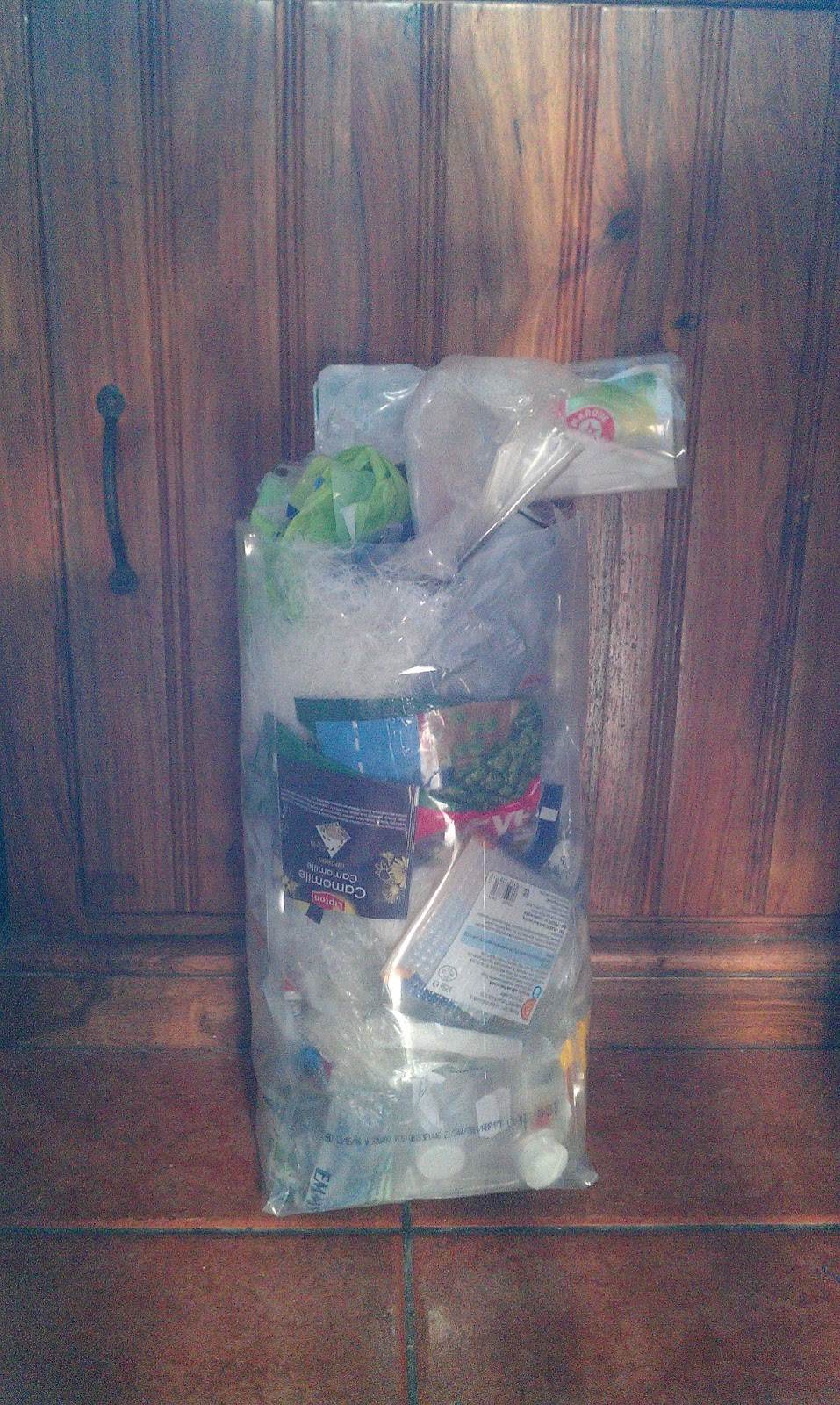
It has been maybe ten years now that the Pitt family have only needed to put their 'general waste' bin out for collection once or twice in a year and even then it hasn't had much in it.  This was the photo of our entire residual waste for 2013.

Residual Waste for 2013
Now, it helps, of course, living in West Oxfordshire, where there really isn't very much at all that can't be recycled in your kerbside collection boxes - and they even take flyaway plastics as long as they are bagged up so they don't fly away during the collection process.  I've also actively taken steps to think about my residual waste each year and have tried to avoid buying things that can't be reused, recycled, composted or burnt on my stove - or things that have packaging that can't be recycled, reused etc.  And I've done that for a while now, so zero waste has become a habit.

But, this morning I put out four black boxes each of which was fairly full of recyclables. I'm pretty sure I put out four boxes, if not five, the week before and similar the week before that.  That's a lot of packaging for one family.  I have taken in the recycling from the cricket club annual dinner and we also had a rather large 18th birthday party, but it really has none-the-less got my attention. So I decided that over the next few weeks I'm going to really try hard to reduce the amount of packaging I amass.

We have for a long time bought much of our fruit and vegetables loose and last year I converted a patch of garden to grow salad herbs in order to provide unpackaged salad leaves.  My local butcher will accept my various reusable plastic boxes for when I buy meat.  I've been experimenting with making homemade snacks, particularly to reduce food waste as well as to reduce packaging.  But there are still so many things that come in a plastic bag.

I came across this write-up of Whole Foods Markets supermarket chain on the plasticisrubbish.com blog and it dawned on me that on one of my now very occasional journeys that I still make by car I drive right past the one in Cheltenham.  So today, I went prepared with a reusable shopping bag and my tiny bag of 'Onya Weigh Bags' - which are reusable, washable very lightweight mesh bags and checked out the Cheltenham branch of Whole Foods Market.

The selection of fruit and veg looked very inviting, but I had come to investigate those cupboard store ingredients like dried fruit, cereals, rice and pasta that are rarely found sold loose.

I came away with the following haul:


1. UK sourced jumbo oats at £1.09/kg.  The last box of oats I bought - because it was the only one I could see that was UK sourced with entirely recyclable packaging - is currently £2.70/kg in Sainsbury's.

2. Organic arborio rice £2.99/kg.  The last box I bought was priced at £2.20/kg from Sainsbury's.

3. Brown basmati rice at £2.39/kg.  Sainsbury's brown basmati rice is £1.80/kg

4. Organic raisins £5.99/kg. Sainsbury's organic raisins are £5.00/kg but the raisins I usually buy there are £3.00/kg.

5. Dry roasted peanuts £5.39/kg.  The cheapest dry roasted peanuts in Sainsbury's are £4.40/kg but I wouldn't buy them as the packaging isn't recyclable even in West Oxfordshire.  The ones I'd likely buy were £6.70/kg.

Price wise, it seems you win some you loose some.  If I'd bought around a kilo of each item then given the 30p discount Whole Foods Market gave me for using my own bags then I paid £1.15 more than I'd have paid buying what I'd normally buy at Sainsbury's or 85p less if I'd have chosen organic raisins.  I did a taste test on the raisins I had left at home and the ones I'd just bought and the latter were definitely tastier.  I doubt that's just down to freshness as raisins don't last long in our house.

So price-wise I felt it was ok and quality wise and packaging wise I'd give it top marks.  I love the fact that I would soon know exactly how much I can buy to fill my storage containers for each item and I loved the fact that I was left with no packaging to recycle.  I also cheekily took the opportunity to check out my Onya bags on the scales compared to the paper bags the shop provides and my Onya bags weighed a tiny bit less.  I will be shopping there again next time I pass.

I was only disappointed that there was no bulk buy plastic free pasta.  So it looks like I will have to try and make my own :)


Friday, 24 October 2014

Recycling Polystyrene

Yesterday I was asked this question on Twitter…

Technically the answer is 'Yes' - Polystyrene can be recycled and I learnt when I visited the Resource and Waste Management Show in Birmingham last year that it is recycled in the UK.

The map on this link shows you where in Britain you can find polystyrene recycling points.

But likely the more practicable answer here is NO.  Why?  The problem lies in collecting waste streams for stuff that is not an everyday waste item.  In addition, polystyrene is very light and bulky- it is actually 98% air!  That's the reason it is a good item for packaging, but a bad item for recycling.

In West Oxfordshire we are asked to put polystyrene into our grey rubbish bins - the ones for residual waste.  Would I do that?  NO WAY!

Polystyrene is one of those things I actively avoid whenever I can so I don't get a lot of it.  For instance I won't buy something in a supermarket that is packed in a polystyrene food tray.  I don't understand why a food processing company would choose a material that is so rarely recycled to package something they want us to buy on a regular basis and so I won't give them my business. Plain as that!

However, I have found that people will bring things to my house that are packed in polystyrene and occasionally I have had parcels arrive protected by polystyrene or filled with polystyrene pellets.  So what do I do with them?

I turn it into a resource and reuse it.

A timely project for polystyrene right now is for potting up my geraniums to bring them indoors for the winter, which I do every year towards the end of October.  Of course, I save the polystyrene from previous years but each year my geranium collection grows by about half a dozen plants as I take cuttings and separate bits of plant that have naturally rooted during the year.  So I always need a bit more polystyrene or broken crock for the bottom of the plant pots. For this purpose, I keep a bucket in my garage into which any bits of polystyrene or broken cups and plates get stored until I need them.

This is last year's stock about to get used this weekend.


A couple of other projects that have used up my stock of polystyrene lately:

This planter that Mr Pitt made for me out of some recycled wooden planks needed quite a lot of drainage in the bottom.  Polystyrene was ideal for that as it does the job of rocks and pebbles - but without the weight.  It keeps the soil in but allows the water to find ways through and creates a dry zone between the soil and the wooden base of the planter so that the wood doesn't rot.


You may notice that it also used up my collection of bits of oasis from various flower arrangements acquired at weddings, several cricket dinners and a few other events.  I always knew I'd find a use for it eventually!

Secondly, my local community shop that raises lots of money for our village clubs and societies sells quite a few fragile things, so I recently took a bag full of tissue paper and some polystyrene packaging pellets to them, which they said they were always in need of.

If you don't have storage space for your polystyrene in a garage for example then you could maybe put it on Freegle.  I often find things will go same day or within a couple of days.  People use polystyrene sheets as insulation in greenhouses.  It would make a reasonable substitute for oasis for dried flower arrangements too.